As Baltimore wrestles with the difficult decision between closing fire stations or selling adspace on fire trucks, Michael Cooper reports on an approach more and more cities are taking to curb budget shortfalls.


Corporate advertising and naming rights are common on buses and sports arenas. But what about naming rights for transit stations? Or ad space on fire hydrants? Many cities, in the face of financial constraints, are looking for creative ways to fund basic public amenities such as police and fire services. Baltimore's City Council recently passed legislation urging officials to pursure advertisment opportunities for fire trucks in an effort to keep 3 doomed fire stations open.
William Welch, City Councilor and author of the legislation says, "...we can't tax people out of existence. We're trying, our mayor's trying, to bring 10,000 more people back to Baltimore city. And if you have an increasing fee or tax structure, you're not going to be able to do that. So you have to create alternatives."
The trend in city sell-outs isn't popular with everyone, however. Elizabeth Ben-Ishai, is the campaign coordinator for the Public Citizen's Commercial Alert project, an organization that works to stem commertialization. As she points out, "We are bombarded by ads everywhere we go, and these are public spaces meant to be reflective of the values of our society, co-opted by the private sector,"
Thanks to Jessica Brent
Read the full story: Your Ad Here, on a Fire Truck? Broke Cities Sell Naming Rights

Toward Better Advertising Campaigns for Transit
A few ideas on how advertisements could do a better job of selling public transit to the public.
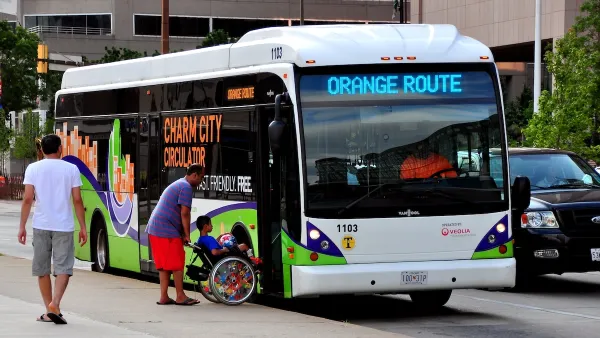
Baltimore to break ground on $50 million Transit Priority Project
The project will bring faster bus trips, safer streets and better bike connections to Baltimore.
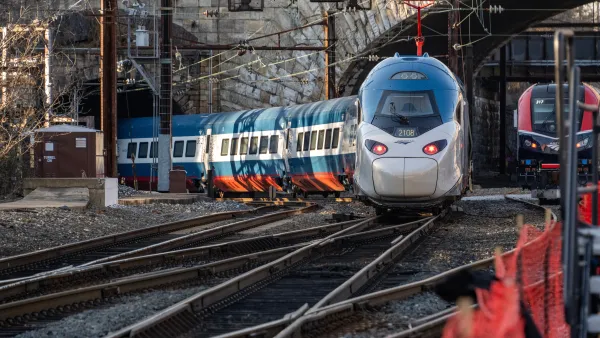
Amtrak’s $6 billion tunnel project moves closer to a faster Northeast Corridor
The Baltimore & Potomac Tunnel Replacement Program is Amtrak's largest-ever single infrastructure investment, and will pave the way for more reliable passenger rail service between Baltimore, Washington and Virginia.

Planetizen Federal Action Tracker
A weekly monitor of how Trump’s orders and actions are impacting planners and planning in America.

Amtrak, CN end decades-long dispute with eight-year agreement
The new operating agreement establishes an updated framework for the companies to work together, including processes to resolve disputes.

Northwest rail fans eager for Sept. 30 debut of Amtrak’s Airo fleet
Get ready for that new train smell and more seats. But they won’t go faster or run more frequently on the Cascades route in Washington and Oregon.

Record-breaking wildlife overpass in Colorado brings 91% reduction in animal collisions
Prior to the overpass, vehicles were hitting one deer per day on Colorado’s Interstate 25.

California lawmakers approve just 5% of much-needed LA28 transportation funding
State legislators appear just as unwilling as Trump to pay for Olympics-related transportation projects.

MTA looks to bring AI-assisted, multilingual announcement system to subways
Some of the transit agency’s audio systems haven’t been upgraded in 40 years.

FREE Course: Walkable City 1: Why Walkability?
After describing his path towards focusing on walkability as the essence of good planning, Jeff Speck marches through his five principal reasons for making more walkable places.
Reinventing Malls: Planning Alchemy—Turning Gray Fields Into Gold
The course focuses on the opportunities and imperatives that shape reinvention of mall sites.

City of Thousand Oaks
City of Wisconsin Rapids
Harvard University Graduate School of Design
The Architects Foundation
University of Cincinnati Online
The Pocatello Development Authority
The Urban Renewal Agency of the City of Pocatello