Recent recipient of the ASLA's Gold Medal, landscape architect Laurie Olin shares some interesting opinions on his distinguished career, landscape urbanism, and the state of public space.


In a conversation with AN West Coast editor Sam Lubell, Olin shares his insights on the changing role of landscape architects in the creation of urban environments:
"In the last decade or so, many architects have become deeply engaged in ecology and energy and systems-the way landscape architects have always been, which is good and healthy and proper. And so we now realize cities aren't just architecture. For a long time people tried to solve something called urban design. Some people tried to make urban design a discipline. We in landscape architecture would argue that urban design isn't a discipline, it's an activity that lots of disciplines do together. It's ensemble work. None of us can control it and none of us can do it all."
On the importance of cities and streets:
"...learning how to make cities rich and fecund and great places to be so we're comfortable and healthy and happy is the biggest problem we face. The only way we'll not go crazy is to build beautiful, rich, life-enhancing cities....The majority of open spaces in cities are streets. That means the street system is too important to leave to transportation engineers. They're way too important to leave to just moving traffic. So I'm interested in cities because they are the design problem for a habitable planet."
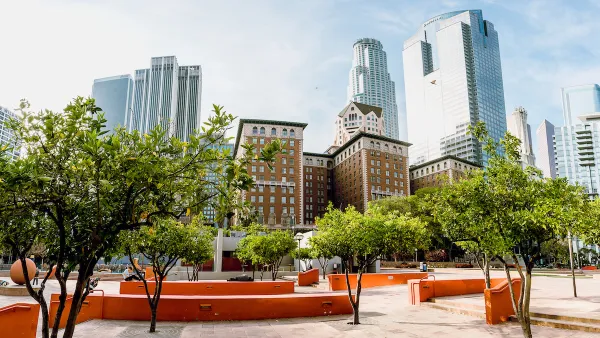
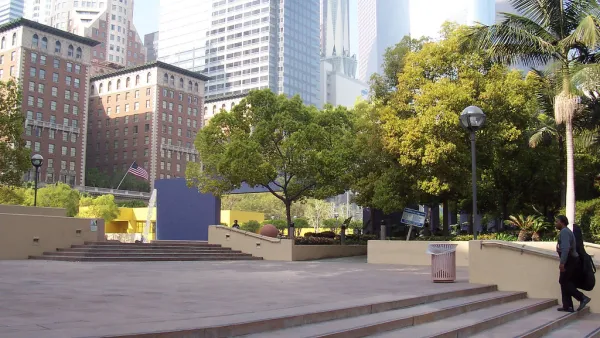
On the failure of Pershing Square in Los Angeles:
"When Ricardo Legorretta and I did Pershing Square, which everybody hates now, we gambled on the fact that Anglos would come down from the towers and Hispanics would come over, and of course they haven't. The citizens group that was the client collapsed and went away. One of the biggest disappointments of my life was our thinking that we knew what we were doing in that situation and we didn't."
Read the full story: Q+A> Laurie Olin

Pershing Square, Downtown L.A.’s ‘Forgotten Park,’ Begins Long Awaited Revamp
A makeover that began in 2015 is finally underway in 2023, but the process of reconstructing Pershing Square is expected to proceed incrementally.

Draft Los Angeles River Master Plan Revealed
A new draft Los Angeles Master Plan, created by Frank Gehry's firm, lays out a more active, natural vision for the river, in addition to addressing concerns about displacement in communities along the river corridor.
L.A.'s Pershing Square Headed for Redesign
The first phases of a plan to remake the downtown Los Angeles plaza into a more inviting, accessible public space are going to kick off soon.

Planetizen Federal Action Tracker
A weekly monitor of how Trump’s orders and actions are impacting planners and planning in America.

California plans to bury El Niño’s downpour
If the state plays its cards right, it may be able to store a billion acre-feet of El Niño’s water in aquifers.

Chicago breaks ground on $3 billion megadevelopment
The new neighborhood, titled Foundry Park, will one day host 3,700 residences.

One of Denver’s busiest corridors to gain BRT
The project will span 18 miles and contain 74 bus rapid transit stations.

275,000 bus trips are at stake on Seattle's ballot
If passed, the Seattle Transit Measure would trigger a 0.3% sales tax and raise an average of $138 million per year to maintain and expand Seattle’s bus services.

Texas may pay Israeli company billions to ease water woes
Texas awarded IDE Technologies the contract for its Harbor Island project, which is slated to become the Western Hemisphere's largest desalination plant.

FREE Course: Walkable City 1: Why Walkability?
After describing his path towards focusing on walkability as the essence of good planning, Jeff Speck marches through his five principal reasons for making more walkable places.
Reinventing Malls: Planning Alchemy—Turning Gray Fields Into Gold
The course focuses on the opportunities and imperatives that shape reinvention of mall sites.

City of Rosemead
Rutgers University, Edward J. Bloustein School of Planning and Public Policy
One Hundred Miles
Hunter College, City University of New York (CUNY)
The Architects Foundation
University of Cincinnati Online
City of Cambridge
Montrose County
The Pocatello Development Authority