Joanna Zelman reports on the good news and bad news contained in the American Lung Association's just released study, "State of the Air 2012." If you live in California, you may not want to read on.


Released Wednesday, the State of the Air report examined 2008-2010 ozone levels, the main ingredient of smog air pollution, and air-particle pollution at official measuring sites across the U.S.
Big picture, there was good news to be had. "Out of the 25 cities with the most ozone pollution, 22 saw improvements in air quality over last year's report. Similar advancements were seen among cities with the most year-round particle pollution," notes Zelman. Unfortunately, the good news didn't go much further. "More than 127 million Americans -- about 41 percent of the country -- still suffer from pollution levels that can make breathing dangerous."
In the rankings of the regions with the most year-round particle pollution, the first five of the top ten are all located in California, with 1) Bakersfield and Delano, 2) Hanford and Corcoran, and 3) Los Angeles, Long Beach, and Riverside, leading the list.
According to Zelman, "California regions face challenges due in part to the agricultural processes, weather and goods-movement industry there. The goods-movement industry includes everything from ships, trucks and trains to machines that load and unload freight and stock store shelves."
FULL STORY: State Of The Air 2012: American Lung Association Reports Improvements, Challenges

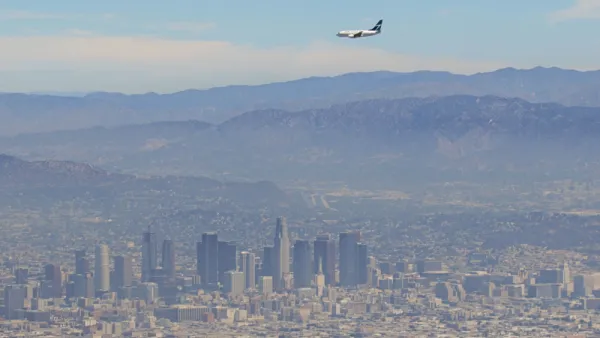
'State of the Air Report' Finds More Cities With Worsening Pollution
The American Ling Association released its "State of the Air" report last week, finding that ozone and short-term particle pollution worsened in many cities in 2015-2017, compared to 2014-2016.
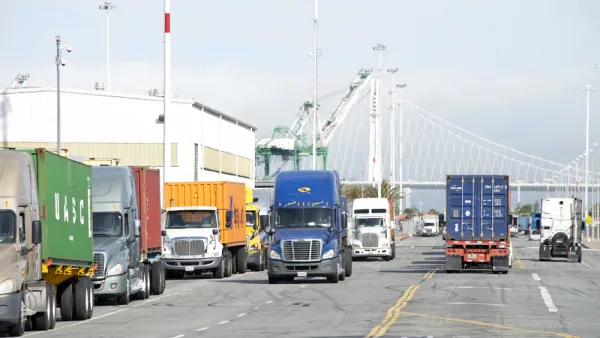
Two New California Laws Take Aim at Pollution from Heavy-Duty Trucks
Trucks, which disproportionately contribute toward air pollution, will soon be subject to similar types of smog checks that apply to light-duty vehicles. A second bill signed by Gov. Gavin Newsom will spur movement toward cleaner alternatives.
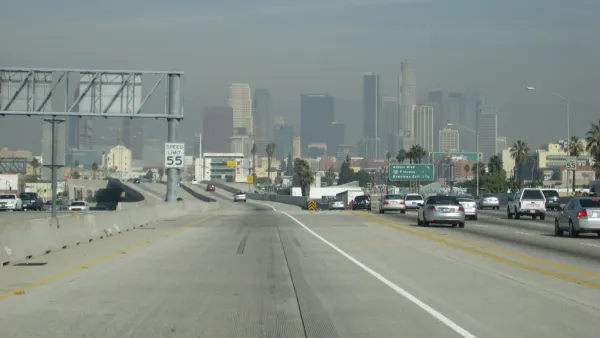
California Has 8 of the 10 Most Polluted Cities in the U.S.
Despite ever-stricter air-quality regulations and dropping emissions, the American Lung Association once again finds the state to have some of the worst air in the nation.

Planetizen Federal Action Tracker
A weekly monitor of how Trump’s orders and actions are impacting planners and planning in America.

The state-sanctioned urbicide of Austin
People don’t kill cities. Freeways do.

US to reduce Colorado River water deliveries to Mexico
A new Colorado Treaty amendment reduces Mexico’s Colorado River water allocation by 250,000 acre feet.

5 New England states march closer to 800 megawatt wind energy project
Securing federal approval for the project may be complicated under the Trump administration, which has historically been hostile towards domestic wind power.

Baltimore to break ground on $50 million Transit Priority Project
The project will bring faster bus trips, safer streets and better bike connections to Baltimore.

Airbnb launches $250 million 'last-dollar financing' housing accelerator, makes first investment in Austin
The company will put $6.4 million towards affordable housing development in Texas’ capital.

FREE Course: Walkable City 1: Why Walkability?
After describing his path towards focusing on walkability as the essence of good planning, Jeff Speck marches through his five principal reasons for making more walkable places.
Reinventing Malls: Planning Alchemy—Turning Gray Fields Into Gold
The course focuses on the opportunities and imperatives that shape reinvention of mall sites.

Eagle County Government
Harvard University Graduate School of Design
Nashville Planning Department
The Architects Foundation
University of Cincinnati Online
The Pocatello Development Authority
The Urban Renewal Agency of the City of Pocatello
Journal of the American Planning Association