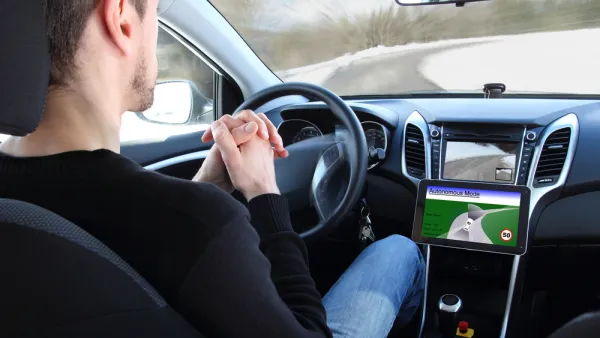
Tom Vanderbilt writes about the current crop of self-driving cars in Wired. "After almost a hundred years in which driving has remained essentially unchanged, it has been completely transformed in just the past half decade."


Vanderbilt tracks the stunning advances in autonomous automobiles achieved over just the last few years; and it won't be long until our cars drive themselves.
"The last time I was in a self-driving car-Stanford University's 'Junior,' at the 2008 World Congress on Intelligent Transportation Systems-the VW Passat went 25 miles per hour down two closed-off blocks. Its signal achievement seemed to be stopping for a stop sign at an otherwise unoccupied intersection. Now, just a few years later, we are driving close to 70 mph with no human involvement on a busy public highway-a stunning demonstration of just how quickly, and dramatically, the horizon of possibility is expanding. "This car can do 75 mph," [Chris] Urmson says. "It can track pedestrians and cyclists. It understands traffic lights. It can merge at highway speeds."
Read the full story: Let the Robot Drive: The Autonomous Car of the Future Is Here

Michigan Bill Would Be First to Allow Cars to Drive Without Humans
A state legislation package is aiming to clear hurdles obstructing the development of autonomous vehicles.
Self-Driving Cars Coming Soon to A Street Near You
...particularly if you live in Nevada, where Google is pressing hard to convince lawmakers to allow their autonomous vehicles on public roads.

Google will fund removal of 2000 acres of trees in Oklahoma to save water while building new data center
The company has invested $30 million into projects intended to address Oklahoma’s water shortage.

Planetizen Federal Action Tracker
A weekly monitor of how Trump’s orders and actions are impacting planners and planning in America.

Amtrak, CN end decades-long dispute with eight-year agreement
The new operating agreement establishes an updated framework for the companies to work together, including processes to resolve disputes.

Northwest rail fans eager for Sept. 30 debut of Amtrak’s Airo fleet
Get ready for that new train smell and more seats. But they won’t go faster or run more frequently on the Cascades route in Washington and Oregon.

Atlanta City Council unanimously backs $3.5 billion Beltline light rail project
The resolution was drafted after Atlanta Mayor Andre Dickens pulled support for the Atlanta Streetcar extension last year.

SEPTA to bring nearby frequent transit to over 1 million new riders as part of decade-long plan
The agency's Accelerate plan will also bring frequent transit to twice the amount of jobs that are currently located near it.

NYC plants over 18,000 trees, the most new foliage in a decade
Many of the trees were planted in communities vulnerable to extreme heat.

FREE Course: Walkable City 1: Why Walkability?
After describing his path towards focusing on walkability as the essence of good planning, Jeff Speck marches through his five principal reasons for making more walkable places.
Reinventing Malls: Planning Alchemy—Turning Gray Fields Into Gold
The course focuses on the opportunities and imperatives that shape reinvention of mall sites.

City of Thousand Oaks
City of Wisconsin Rapids
Harvard University Graduate School of Design
The Architects Foundation
University of Cincinnati Online
The Pocatello Development Authority
The Urban Renewal Agency of the City of Pocatello