Can the community of Long Beach, California use examples from much larger places like San Francisco and East Village to reclaim its extensive public alleys?


Writer Jesus Hernandez explores the alleys in the Southern California coastal city of Long Beach, and considers how the city's alleys might have more than a utilitarian function:
"...Alleys make up a significant portion of Long Beach's public right-of-way space, and there is value in viewing them as more than a home for forgotten mattresses and rusted clunker cars. With some foresight and investment, they can become living lanes, lush with landscaping and filled with art, extensions of bike and pedestrian networks as well as the city's public parks. It might take some vision to scratch away initial layers of grime, but we can find examples across California and beyond from which to draw inspiration."
Thanks to Brian Ulaszewski
Read the full story: A Better Alley
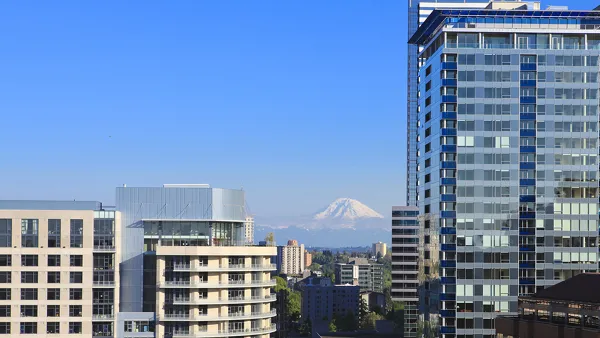
2020 Population Growth Rates for the 50 Biggest U.S. Cities
The Census Bureau released new data on May 27 that includes the first four months of the pandemic. Seattle tops the growth rate at 2.2% from July 1, 2019, to July 1, 2020, while Baltimore and San Francisco land at the bottom with -1.4%.
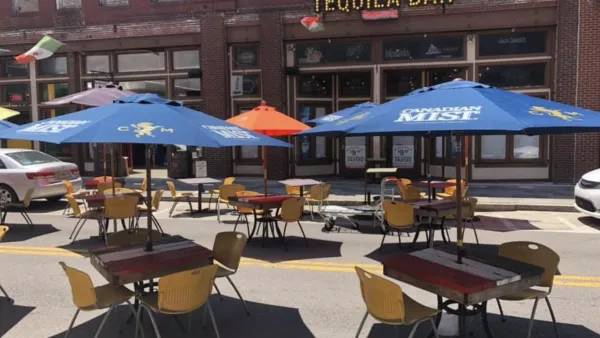
The Growing Footprint of Al Fresco Streets
The al fresco streets movement, moving dining and retail space into the public realm in space historically devoted to automobiles, continues to gain momentum around the country.
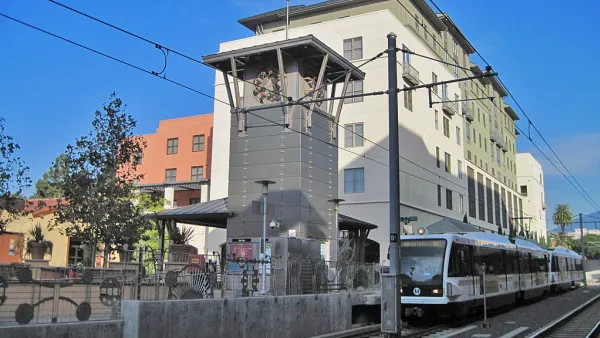
Rent Control Falls Short of the Ballot in Multiple California Cities
Support for rent control is building at the state level in California. Support hasn't been as easy tt rally at the local level, however.

Planetizen Federal Action Tracker
A weekly monitor of how Trump’s orders and actions are impacting planners and planning in America.

California plans to bury El Niño’s downpour
If the state plays its cards right, it may be able to store a billion acre-feet of El Niño’s water in aquifers.

Desperate measures: Advocates weigh draining Lake Powell to fill Colorado River
Draining the reservoir could reduce evaporation losses by a couple hundred thousand acre-feet.

Mamdani’s pied-à-terre tax survives legal challenge
A panel of judges found that the plaintiffs failed to demonstrate injury as a result of New York City's implementation of the tax.

Eastern Nebraska is running out of electricity
Data centers and electrification are straining eastern Nebraska’s grid, throttling economic development.

Seattle passes record-breaking transit services expansion
Proposition 1 will double the city’s transit tax to add 95,000 more bus trips and preserve 180,000 bus trips annually.

FREE Course: Walkable City 1: Why Walkability?
After describing his path towards focusing on walkability as the essence of good planning, Jeff Speck marches through his five principal reasons for making more walkable places.
Reinventing Malls: Planning Alchemy—Turning Gray Fields Into Gold
The course focuses on the opportunities and imperatives that shape reinvention of mall sites.

City of Rosemead
Rutgers University, Edward J. Bloustein School of Planning and Public Policy
One Hundred Miles
University of Michigan School for Environment and Sustainability (SEAS)
Hunter College, City University of New York (CUNY)
The Architects Foundation
City of Cambridge
Montrose County
The Pocatello Development Authority