The Los Angeles City Council last week approved an update to the Los Angeles River Implementation Overlay to encourage good quality river centric development and begin removing some of the concrete that covers the river and its banks.


According to city planner Tom Rothmann, this is the first plan for actually making changes along the river, unlike the Los Angeles River Revitalization Master Plan, which provided more of a visualization exercise. Rothmann told Curbed today that the overlay "requires changes along the river and a quarter-mile buffer around the river."
According to the LA Daily News, the LA-RIO identifies "areas where the concrete could be removed to increase public access to the river, while not creating any flooding problems." Councilmember Ed Reyes tells the paper "there are commercial areas where we are going to them to say, 'You can do more here than have a back of a building facing the river'...We want them to look at other possibilities of having parkways and bike paths."
Read the full story: City Considering Plan To Start Up Un-Paving and Spiffing The LA River

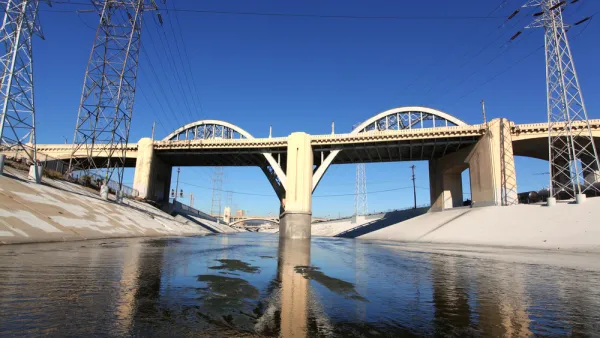
Designing Safe Passage for Steelhead Trout Through the L.A. River
The Southern California steelhead was added to the federal endangered species list in 1997. Today, planners are working to create a new home for the trout in the L.A. River.
A Bold Housing Vision for the L.A. River
An unsolicited proposal from the engineering firm reimagines a stretch along the L.A. River as a mixed-use mega-development, rich in housing and jobs.
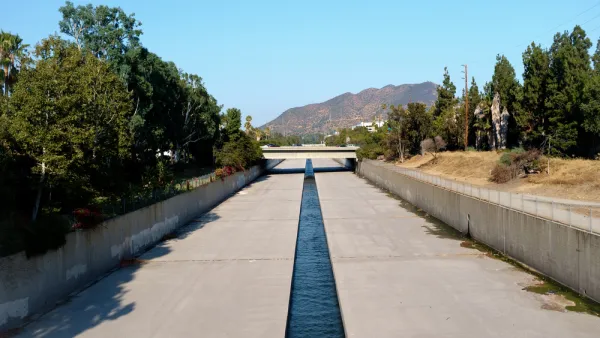
Reality Check: The Los Angeles River Can Still Flood
Sometimes it seems like it will never rain again in Los Angeles, but the river running through the city is still a significant flood risk.

Planetizen Federal Action Tracker
A weekly monitor of how Trump’s orders and actions are impacting planners and planning in America.

Amtrak, CN end decades-long dispute with eight-year agreement
The new operating agreement establishes an updated framework for the companies to work together, including processes to resolve disputes.

Judges permit Denver to divert 77,000 acre feet from the Colorado River for reservoir expansion
Overuse and climate change have caused the Colorado River’s water levels to plummet.

NYC DOT wants faster, more permanent street upgrades
The city is examining ways to build more concrete infrastructure without getting entangled in 'decades-long' projects.

'Something we’ve never seen before:' rising utility rates could strain city finances nationwide
Data centers, climate change and other factors have caused utility rates in the United States to increase by 38% since 2020.

Trump to overrule local leaders, lease millions of acres of America’s Pacific Island territories’ seafloors to mining companies
International law says that the Indigenous people of America’s territories have a right to prior and informed consent regarding projects that impact their countries.

FREE Course: Walkable City 1: Why Walkability?
After describing his path towards focusing on walkability as the essence of good planning, Jeff Speck marches through his five principal reasons for making more walkable places.
Reinventing Malls: Planning Alchemy—Turning Gray Fields Into Gold
The course focuses on the opportunities and imperatives that shape reinvention of mall sites.

Harvard University Graduate School of Design
KFH Group Inc.
Greater Baltimore Committee
The Architects Foundation
University of Cincinnati Online
The Pocatello Development Authority
The Urban Renewal Agency of the City of Pocatello