Transit agencies and railroad companies realize the importance of infrastructure, as their train cars roll over bridges and through tunnels every day. This article looks at advances in bridge construction begin driven by these private industries.


Howard Ande of Progressive Railroading says that there are still some 70-year old timber trestles out there that need to be replaced with concrete:
"Emerging technology could play a role in future bridge projects, such as a hybrid composite beam (HCB), [Norfolk Southern Chief Engineer of Bridges and Structures Jim Carter] says. Comprising a carbon-fiber reinforced concrete arch encased with fiberglass, HCB is undergoing tests at the Transportation Technology Center Inc.'s Facility for Accelerated Service Testing (FAST) track in Pueblo, Colo."
Ande also talks with Union Pacific and the Alaska Railroad Corp. about their bridge-building initiatives.
Read the full story: Railroads aim to replace or revamp aging bridges

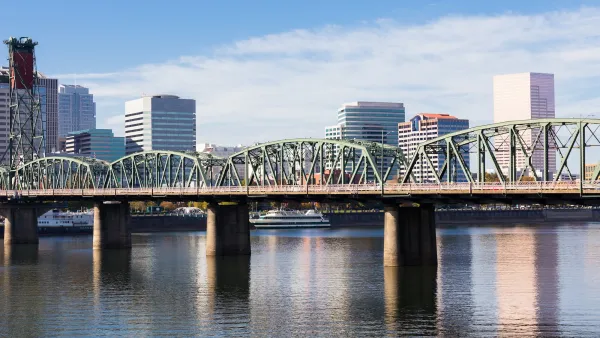
Federal agencies give go-ahead to I-5 Columbia River bridge project
The next few months will clarify whether the massive bridge replacement project will secure the funding to move forward as planned.

Now you can cross from Iowa to South Dakota on a pedestrian bridge
The Big Sioux Pedestrian Bridge connects a park and a golf course on the other side of the Big Sioux River.
April must-reads: Top 10 articles from last month
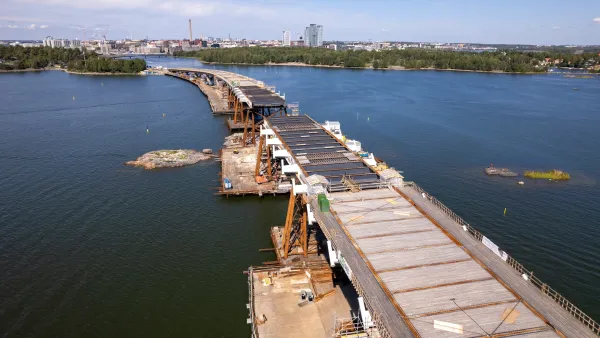
The world's longest car-free bridge opens in Finland, Amtrak's new Mardi Gras line shatters ridership predictions, and Bay Area commuters could lose a third of Caltrain stations.

Planetizen Federal Action Tracker
A weekly monitor of how Trump’s orders and actions are impacting planners and planning in America.

Amtrak, CN end decades-long dispute with eight-year agreement
The new operating agreement establishes an updated framework for the companies to work together, including processes to resolve disputes.

Judges permit Denver to divert 77,000 acre feet from the Colorado River for reservoir expansion
Overuse and climate change have caused the Colorado River’s water levels to plummet.

NYC DOT wants faster, more permanent street upgrades
The city is examining ways to build more concrete infrastructure without getting entangled in 'decades-long' projects.

'Something we’ve never seen before:' rising utility rates could strain city finances nationwide
Data centers, climate change and other factors have caused utility rates in the United States to increase by 38% since 2020.

Trump to overrule local leaders, lease millions of acres of America’s Pacific Island territories’ seafloors to mining companies
International law says that the Indigenous people of America’s territories have a right to prior and informed consent regarding projects that impact their countries.

FREE Course: Walkable City 1: Why Walkability?
After describing his path towards focusing on walkability as the essence of good planning, Jeff Speck marches through his five principal reasons for making more walkable places.
Reinventing Malls: Planning Alchemy—Turning Gray Fields Into Gold
The course focuses on the opportunities and imperatives that shape reinvention of mall sites.

Harvard University Graduate School of Design
KFH Group Inc.
Greater Baltimore Committee
The Architects Foundation
University of Cincinnati Online
The Pocatello Development Authority
The Urban Renewal Agency of the City of Pocatello