Only 7 short years ago, planners in the Phoenix/Tuscon area were envisioning a region of 10 million people. Today they're scaling back the predictions, but still have hope for a recovery.


Tony Davis of the Arizona Daily Star calls it the "lost decade"; the folks he interviewed expect that the downturn will last 5-10 years and then result in a modest recovery in the housing market. Davis talks with Robert Lang, a sociology professor at the University of Nevada-Las Vegas:
"Lang was a bit more optimistic, saying that while the region could endure a "lost decade," it may be more like a lost half-decade if now-depressed housing prices in Tucson and Phoenix begin to make the region seem like a bargain to people living elsewhere.
"Phoenix boomed and busted, but that left the region a real bargain compared to Southern California," said Lang..."
Read the full story: Downturn May Slow Predicted Boom in Prescott/Phoenix/Tucson Corridor

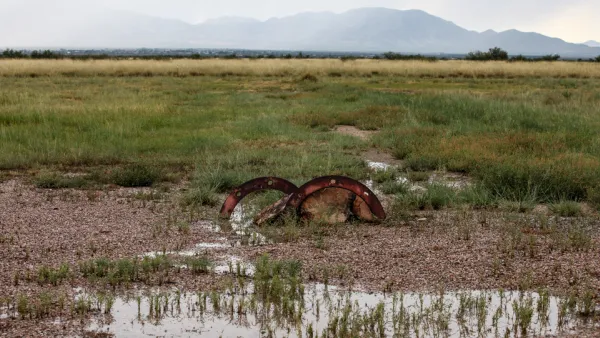
Why Would Arizona Deregulate Groundwater Now?
For decades the arid state has required most new construction projects to demonstrate adequate water supply, but at the edge of the next dry spell, two lawmakers are trying to get rid of the rules.
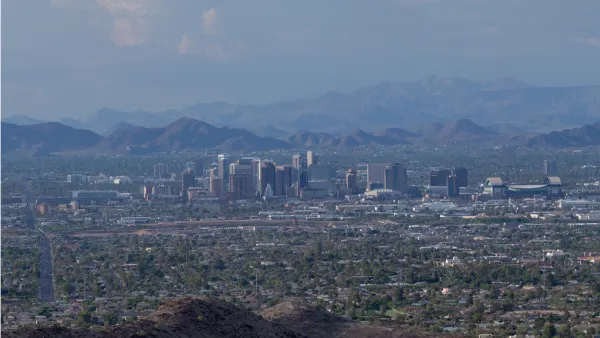
In Phoenix, Sustainability Will Be Built by Node
If the desert metropolis wants to survive, it will need a strategy built on something other than a denser, more urban downtown.
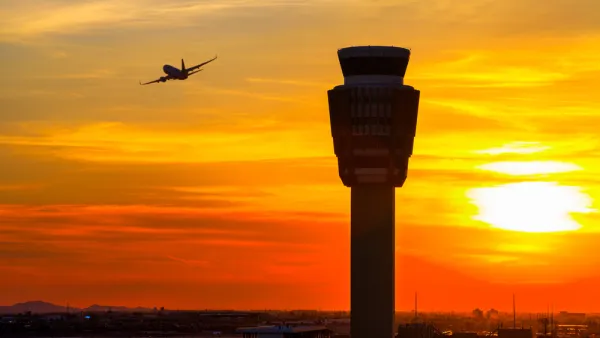
It's Too Hot to Fly in Phoenix Today
A record heatwave and the likelihood for more extreme weather raises alarm in Arizona.

Planetizen Federal Action Tracker
A weekly monitor of how Trump’s orders and actions are impacting planners and planning in America.

Chicago breaks ground on $3 billion megadevelopment
The new neighborhood, titled Foundry Park, will one day host 3,700 residences.

Denver is solving homelessness. Why aren't the rest of us?
Since 2023, Denver's street homeless population has decreased by 64%, proving that effective tools exist to support those in need of housing.

MTA kicks off six-year, $1 billion transit upgrade project
The authority is replacing the roughly 90-year-old train signals on the A and C line with modern technology.

Developers may expand largest gas pipeline network in Northwest
Pipeline giant Williams has proposed new expansions for its Northwest Pipeline from the Colorado Rockies through Idaho, Oregon and Washington.

MBTA is using AI to catch drivers who park illegally
The transit agency is working in partnership with Hayden AI, and hopes the technology will improve transit safety across its network.

FREE Course: Walkable City 1: Why Walkability?
After describing his path towards focusing on walkability as the essence of good planning, Jeff Speck marches through his five principal reasons for making more walkable places.
Reinventing Malls: Planning Alchemy—Turning Gray Fields Into Gold
The course focuses on the opportunities and imperatives that shape reinvention of mall sites.

City of Rosemead
Rutgers University, Edward J. Bloustein School of Planning and Public Policy
One Hundred Miles
The Architects Foundation
University of Cincinnati Online
Montrose County
Northern Illinois Transit Authority (NITA)
The Pocatello Development Authority