In 2001, Eero Saarinen's famed TWA Terminal in John F. Kennedy International Airport closed after American Airlines bought the airline out. Completed in 1962, this terminal is now rarely accessible by the public.


Every Year, Open House New York (OHNY) gives back to New Yorkers by granting them access to locations many hardly ever see. On October 15th and 16th, New Yorkers will have access to the TWA Terminal at John F. Kennedy International Airport which has been closed since 2001.
According to Jane Levere, this years OHNY is a celebration of architecture and design throughout the five boroughs and is expected to draw a record 200,000 participants. All of the weekend's more than 300 activities are meant to unlock New York and provide rare access to sites, tours, talks and special performances that exemplify the city's diverse and culturally rich, man-made environment.
"When completed, the TWA Terminal was an icon of modern design and the golden age of jet travel. But the terminal was considered obsolete with the advent of jumbo jet aircraft, and later decommissioned and closed to the public," says Levere.
Read the full story: Opening Doors to a Hidden New York

The Race Barriers of American Cities
The United States has a long and insidious history of erecting structures to control the movements of African Americans in urban and suburban spaces.
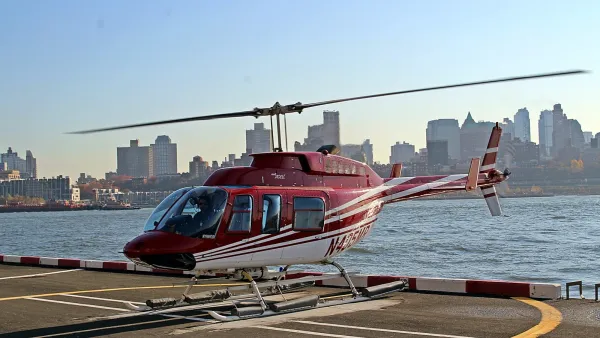
The Elite Helicopter Commutes of N.Y.C.
Helicopters are an exclusive mode that lets those who can afford it avoid the time and inconveniences of on-the-ground travel. But, say critics, it just highlights the gap between the city's haves and have-nots.
Zoning to Protect Manufacturing in N.Y.C.
Development in industrial areas is pushing out manufacturers, but new zoning regulations could help control the incursion.

Planetizen Federal Action Tracker
A weekly monitor of how Trump’s orders and actions are impacting planners and planning in America.

California plans to bury El Niño’s downpour
If the state plays its cards right, it may be able to store a billion acre-feet of El Niño’s water in aquifers.

Desperate measures: Advocates weigh draining Lake Powell to fill Colorado River
Draining the reservoir could reduce evaporation losses by a couple hundred thousand acre-feet.

Mamdani’s pied-à-terre tax survives legal challenge
A panel of judges found that the plaintiffs failed to demonstrate injury as a result of New York City's implementation of the tax.

Eastern Nebraska is running out of electricity
Data centers and electrification are straining eastern Nebraska’s grid, throttling economic development.

Seattle passes record-breaking transit services expansion
Proposition 1 will double the city’s transit tax to add 95,000 more bus trips and preserve 180,000 bus trips annually.

FREE Course: Walkable City 1: Why Walkability?
After describing his path towards focusing on walkability as the essence of good planning, Jeff Speck marches through his five principal reasons for making more walkable places.
Reinventing Malls: Planning Alchemy—Turning Gray Fields Into Gold
The course focuses on the opportunities and imperatives that shape reinvention of mall sites.

City of Rosemead
Rutgers University, Edward J. Bloustein School of Planning and Public Policy
One Hundred Miles
Hunter College, City University of New York (CUNY)
The Architects Foundation
University of Cincinnati Online
City of Cambridge
Montrose County
The Pocatello Development Authority