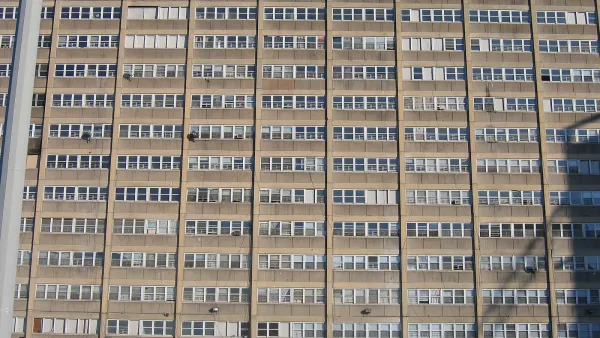
La Lignon, a massive 2,780 unit housing project, was built hastily in the 70s in Switzerland to help manage a massive housing crisis. Today, some people call it home and others call it "a monster."


La Lignon is one of the largest housing projects on Earth, and stretches over 7/10ths of a mile. John Tagliabue reports that public opinion on La Lignon is pertinent today because Switzerland is facing another housing crisis and is in the process of determining what to do about it:
"Le Lignon resembles nothing more than an immense wall, 12 to 14 stories high, snaking across a ridge above the Rhone. On one end stand two high-rise towers with additional apartments. Between the building and the river are a shopping center, Protestant and Catholic churches and a cluster of schools. Four huge underground garages provide parking for tenants."
"Almost from the start, upscale Genevans peered down their noses at the monster of Vernier."
Read the full story: Housing Debate Unfolds in Shadow of a Living Wall

Candyman's Real Horror: American Public Housing Policy
The new film, set in one of America's most notorious public housing projects, highlights the failure of affordable housing policy and its impact on Black communities.
Infamous Watts Public Housing, Reimagined
The Jordan Downs public housing complex in Watts, California is a perfect example of the failed projects of built mid-century. A new proposal would tear down the towers in favor of a mix of building styles connecting to the surrounding area.

Planetizen Federal Action Tracker
A weekly monitor of how Trump’s orders and actions are impacting planners and planning in America.

Amtrak, CN end decades-long dispute with eight-year agreement
The new operating agreement establishes an updated framework for the companies to work together, including processes to resolve disputes.

Judges permit Denver to divert 77,000 acre feet from the Colorado River for reservoir expansion
Overuse and climate change have caused the Colorado River’s water levels to plummet.

NYC DOT wants faster, more permanent street upgrades
The city is examining ways to build more concrete infrastructure without getting entangled in 'decades-long' projects.

'Something we’ve never seen before:' rising utility rates could strain city finances nationwide
Data centers, climate change and other factors have caused utility rates in the United States to increase by 38% since 2020.

Trump to overrule local leaders, lease millions of acres of America’s Pacific Island territories’ seafloors to mining companies
International law says that the Indigenous people of America’s territories have a right to prior and informed consent regarding projects that impact their countries.

FREE Course: Walkable City 1: Why Walkability?
After describing his path towards focusing on walkability as the essence of good planning, Jeff Speck marches through his five principal reasons for making more walkable places.
Reinventing Malls: Planning Alchemy—Turning Gray Fields Into Gold
The course focuses on the opportunities and imperatives that shape reinvention of mall sites.

Harvard University Graduate School of Design
KFH Group Inc.
Greater Baltimore Committee
The Architects Foundation
University of Cincinnati Online
The Pocatello Development Authority
The Urban Renewal Agency of the City of Pocatello