With hundreds of billions of dollars in short-term commercial real estate loans underwater, it's safe to say commercial real estate is in trouble. But can community development corporations confront the lending shortfall?


"Commercial defaults, continued restrictions on commercial lending, and the related problems facing retail ventures in our neighborhoods will have profound implications for economic development projects," writes Marcus Weiss.
But as credit tightens and higher and higher numbers of commercial real estate loans enter default, CDCs are stepping up to fill the financing gap in economic development deals as conventional lenders retreat.
"When Industrial Glass Products, Inc., a minority- and woman-owned specialty glass manufacturer that has operated since 1991 in a Los Angeles neighborhood with 98 percent minority population, observed most of its competitors west of the Mississippi closing their operations, it sought financing to expand," says Weiss. "Finding few banks willing to provide additional capital, it turned to TELACU Community Capital (TCC), a CDFI subsidiary of The East Los Angeles Community Union, one of the nation's largest CDCs. TCC provided a loan for working capital and real estate refinancing. The additional investment capital for machinery, equipment, marketing, and improved production schedules, allowed IGP to pursue customers previously served by competitors. As a CDC with years of experience in development, financing, and government contracting, TELACU understood the subtleties of supporting a company capable of growing jobs while working with a customer base of aerospace and other global firms."
Thanks to Matthew Brian Hersh
Read the full story: Filling the Lending Vacuum

Planetizen Federal Action Tracker
A weekly monitor of how Trump’s orders and actions are impacting planners and planning in America.

Washington state to charge fee to drivers with fuel-efficient cars
Revenue from the fee will go towards supporting the state’s highways.
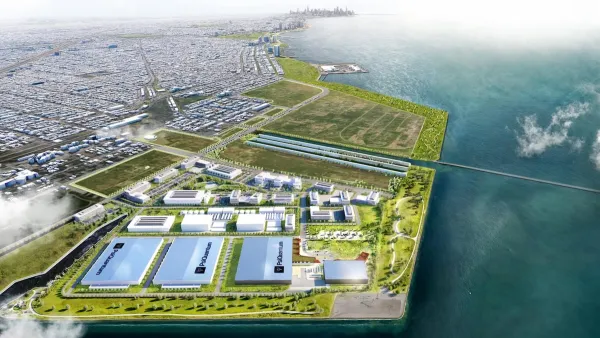
Illinois considers spending $1 billion in taxpayer money on data center
A quantum computing campus and data center are currently under construction in Chicago.

Did data centers change how voters cast their ballots?
Texas, Ohio, and Georgia all flipped party control. But in rural counties, the effect of local data centers was mixed.

Amtrak invests in eight new Airo trainsets
The new trainsets will begin serving passengers in 2031.

HUD to end aid for mixed-immigration-status households
The new rule is projected to impact 80,000 people, nearly half of whom are children.

FREE Course: Walkable City 1: Why Walkability?
After describing his path towards focusing on walkability as the essence of good planning, Jeff Speck marches through his five principal reasons for making more walkable places.
Reinventing Malls: Planning Alchemy—Turning Gray Fields Into Gold
The course focuses on the opportunities and imperatives that shape reinvention of mall sites.

City of Charlotte
City of Rosemead
Rutgers University, Edward J. Bloustein School of Planning and Public Policy
University of Michigan School for Environment and Sustainability (SEAS)
Hunter College, City University of New York (CUNY)
The Architects Foundation
University District Partnership