Plans to redesign the expanded publicly accessible section of the White House's front lawn combine both walkability concerns and safety concerns.


The design by Roger Marvel Architects was recently announced as the winner of a competition to design the new park.
"At the heart of RMA's Washington D.C. design is the strategic layering of security perimeters, which form a flexible boundary accommodating a variety of security scenarios. To accomplish this, the architects raised the central ellipse and placed an anti-ram wall that doubles as a bench around its perimeter; the bench seating faces the ellipse and helps define the iconic space. According to RMA, this elevational tilting formally "presents" the ellipse lawn to the White House while also screening nearby parking spaces from the view of park goers. Punctuating the new perimeter wall are distinct pedestrian entrances with sculptured bollards to help guide pedestrian flow.
This new boundary allows for the pedestrianization of E Street facing the White House. RMA vastly expanded the public space forming a large plaza-the E Street Terrace-flanked by leafy groves containing concession and maintenance structures."
Read the full story: Rogers Marvel Secures Competition to Revamp White House Lawn Extension
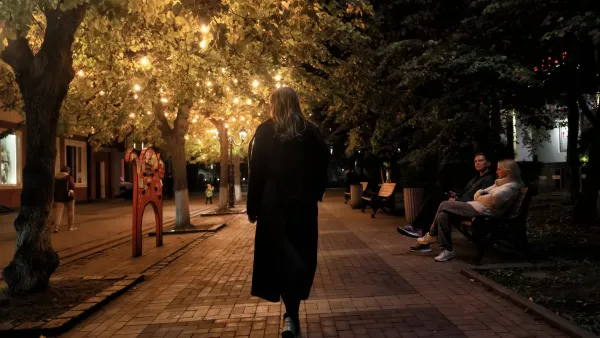
How urban design can deter crime
Well-designed public spaces and good lighting can prevent crime and make residents feel safer.
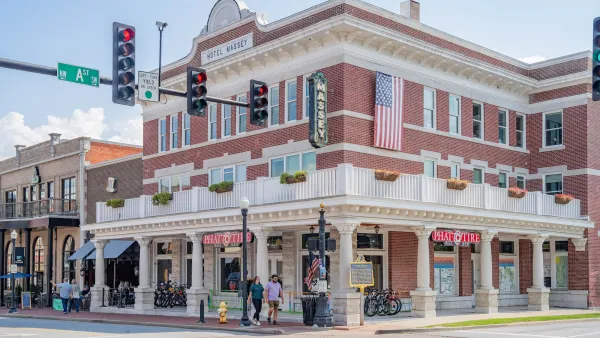
A New Urbanist’s roadtrip guide to Northwest Arkansas
Heading to the CNU conference next month? A Northwest Arkansas urban planner has custom designed a roadtrip just for you.

India’s Women-only ‘Pink Parks:’ Safe Refuge or Segregated Enclaves?
Women-only public spaces can provide safety and community, but critics argue they fail to address deeper structural problems.

Washington state to charge fee to drivers with fuel-efficient cars
Revenue from the fee will go towards supporting the state’s highways.

Illinois considers spending $1 billion in taxpayer money on data center
A quantum computing campus and data center are currently under construction in Chicago.

Trump to blast ‘hydrocarbon highway’ through ‘world’s longest art gallery’
Environmental and historic preservation groups are suing to stop the project.

Boston City Council votes to no longer mandate parking in residential developments
The Boston Zoning Commission still needs to approve the proposal.

Passengers in New York, California lift off in air taxis
Two air taxi companies have received a Special Airworthiness Market Survey Certificate, which allows them to service passengers.

MTA to upgrade subway signals for entire network by 2050
This is the first time New York City has planned to modernize subway signals in the Bronx.

FREE Course: Walkable City 1: Why Walkability?
After describing his path towards focusing on walkability as the essence of good planning, Jeff Speck marches through his five principal reasons for making more walkable places.
Reinventing Malls: Planning Alchemy—Turning Gray Fields Into Gold
The course focuses on the opportunities and imperatives that shape reinvention of mall sites.

City of Charlotte
City of Rosemead
Rutgers University, Edward J. Bloustein School of Planning and Public Policy
University of Michigan School for Environment and Sustainability (SEAS)
Hunter College, City University of New York (CUNY)
The Architects Foundation
University District Partnership