When people love a city, it succeeds. That's the semi-obvious conclusion of a recent survey. So why aren't we working hard to make cities people will love?


Author Peter Kageyama 2008's Gallup Soul of the Community survey, found strong correlations between peoples' emotional attachment to the communities they lived in and higher levels of local GDP:
"These results should not be surprising - we all recognize that when children, pets, plants or even objects are loved, they thrive (yes objects – just look at the car of someone who loves it). So this emotional dimension to infrastructure should not be seen as superfluous." writes Kageyama.
Kageyama wonders why cities don't build more dog parks and public art that kids can play on, which are both high on the 'love' scale.
Read the full story: Why Aren't We Building 'Emotionally Connected' Cities? A Guest Post
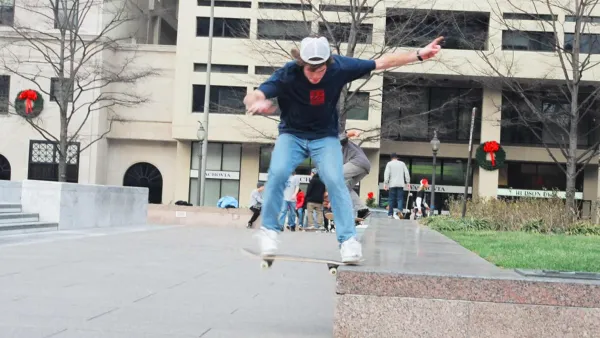
Trump's DC 'beautification' efforts threaten historic skate spots
The city is taking more aggressive measures to prevent skateboarders from using unsanctioned public spaces.

Public Pools: A Threatened Amenity?
Municipal pools offer important benefits to urban residents, but some cities are struggling to keep them open.

City Parks as Cooling Centers
Strategies for making parks cool, inviting community cooling centers during extreme heat.

Desperate measures: Advocates weigh draining Lake Powell to fill Colorado River
Draining the reservoir could reduce evaporation losses by a couple hundred thousand acre-feet.

Eastern Nebraska is running out of electricity
Data centers and electrification are straining eastern Nebraska’s grid, throttling economic development.

Move over, LA: St. Louis gears up for Olympics, invests millions in downtown redevelopment
The Missouri city will host the 2028 Olympic soccer group stage and knockout matches.

Mass. votes against statewide minimum lot size for single-family homes
Over 2 million residents voted on Question 7; it was decided by just over 30,000 votes.

Maryland’s $15 billion bridge project gains key approval
The Maryland Transit Authority said the project will create over 60,000 jobs and add $23 billion to the local economy.

‘No clear next steps’ for Chicago's permanent festival grounds
Eleventh Ward Ald. Nicole Lee has suggested Soldier Field as a possible location for the permanent event space.

FREE Course: Walkable City 1: Why Walkability?
After describing his path towards focusing on walkability as the essence of good planning, Jeff Speck marches through his five principal reasons for making more walkable places.
Reinventing Malls: Planning Alchemy—Turning Gray Fields Into Gold
The course focuses on the opportunities and imperatives that shape reinvention of mall sites.

City of Rosemead
Rutgers University, Edward J. Bloustein School of Planning and Public Policy
One Hundred Miles
University of Michigan School for Environment and Sustainability (SEAS)
Hunter College, City University of New York (CUNY)
The Architects Foundation
City of Cambridge
Montrose County
The Pocatello Development Authority