Is urban planning losing its relevance as a profession? Some say yes. In this essay from Places, Thomas Campanella suggests that the roots of this fall from grace lie in the era of Jane Jacobs.


Campanella cites "[a] swelling perception, especially among young scholars and practitioners, that planning is a diffuse and ineffective field, and that it has been largely unsuccessful over the last half century at its own game: bringing about more just, sustainable, healthful, efficient and beautiful cities and regions. It was there because of a looming sense that planners in America lack the agency or authority to turn idealism into reality, that planning has neither the prestige nor the street cred to effect real change.
To understand the roots of this sense of impotence requires us to dial back to the great cultural shift that occurred in planning beginning in the 1960s. The seeds of discontent sown then brought forth new and needed growth, which nonetheless choked out three vital aspects of the profession - its disciplinary identity, professional authority and visionary capacity."
he suggests that looking at the legacy of Jane Jacobs helps to show how in some ways the profession of urban planning has been diminished in the eyes of the public.
FULL STORY: Jane Jacobs and the Death and Life of American Planning

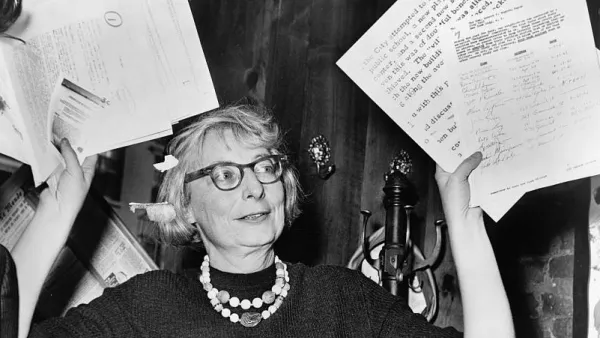
Deconstructing Saint Jane
The iconic urban thinker has influenced generations of planners, but how do her ideas hold up in an age of massive upheaval and economic inequality?
Jane Jacobs's Legacy: 2016 Edition
New York magazine offers a long reflection on the shifting lessons offered by Jane Jacobs after a year of new books and a re-emergence into the public eye.

A First Look at the Opera About Robert Moses and Jane Jacobs
The creators of A Marvelous Order—an opera based on the lives of Robert Moses and Jane Jacobs—have released a video providing a first peek at the songs and ideas behind the opera.

Planetizen Federal Action Tracker
A weekly monitor of how Trump’s orders and actions are impacting planners and planning in America.

The state-sanctioned urbicide of Austin
People don’t kill cities. Freeways do.

US to reduce Colorado River water deliveries to Mexico
A new Colorado Treaty amendment reduces Mexico’s Colorado River water allocation by 250,000 acre feet.

5 New England states march closer to 800 megawatt wind energy project
Securing federal approval for the project may be complicated under the Trump administration, which has historically been hostile towards domestic wind power.

Baltimore to break ground on $50 million Transit Priority Project
The project will bring faster bus trips, safer streets and better bike connections to Baltimore.

Airbnb launches $250 million 'last-dollar financing' housing accelerator, makes first investment in Austin
The company will put $6.4 million towards affordable housing development in Texas’ capital.

FREE Course: Walkable City 1: Why Walkability?
After describing his path towards focusing on walkability as the essence of good planning, Jeff Speck marches through his five principal reasons for making more walkable places.
Reinventing Malls: Planning Alchemy—Turning Gray Fields Into Gold
The course focuses on the opportunities and imperatives that shape reinvention of mall sites.

Eagle County Government
Harvard University Graduate School of Design
Nashville Planning Department
The Architects Foundation
University of Cincinnati Online
The Pocatello Development Authority
The Urban Renewal Agency of the City of Pocatello
Journal of the American Planning Association