Leaders in Charleston County have reversed course on a $500 million highway expansion plan, following public outcry.


Officials in Charleston, South Carolina have unanimously rejected a plan for a half-billion-dollar highway expansion. Angie Schmitt at Streetsblog has the story:
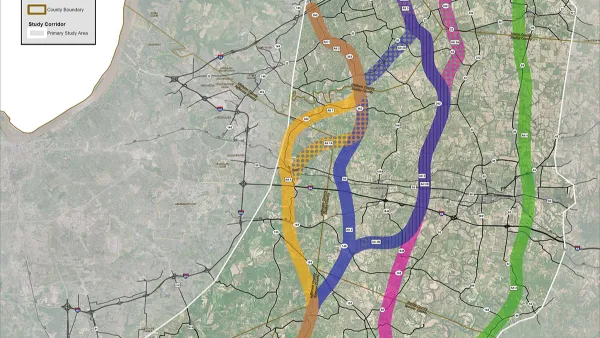
"In an 8-0 decision late last week, Charleston County officials voted against an eight-mile bypass plan that was sure to induce sprawl and promote car-dependence.
Local media sources have reported that it might be possible for the state to continue the project without the county's permission, under the terms of the contract between SCDOT and Charleston County. And it's still not clear if the county will be forced to reimburse the state for the $12 million already spent on planning.
Advocates for a more livable Charleston still have a huge reason to celebrate."
Schmitt talks to local environmental groups about the decision, as well as CNU president John Norquist.
Thanks to Angie Schmitt
Read the full story: Paradigm Shift in Charleston: County Leaders Reject Highway Expansion

Kentucky Planning a New Freeway Around Louisville, Raising Alarms
Local news sources are shedding light on planning for a new highway route that could pass through sensitive habitat of endangered that has yet to undertake a formal environmental or public input process.
In Charleston, an Affordable, Effective Alternative to a Freeway
A Charleston environmental group has suggested an alternative to a proposed expansion of Interstate 526 which solves the congestion problem with refinements to local streets and costs half the price.

California Environmental Leaders Call on State Agencies to Prioritize Multimodal Transportation
Even before President Trump took office, California was not meeting its emissions reduction goals.

Planetizen Federal Action Tracker
A weekly monitor of how Trump’s orders and actions are impacting planners and planning in America.

Amtrak, CN end decades-long dispute with eight-year agreement
The new operating agreement establishes an updated framework for the companies to work together, including processes to resolve disputes.

Judges permit Denver to divert 77,000 acre feet from the Colorado River for reservoir expansion
Overuse and climate change have caused the Colorado River’s water levels to plummet.

NYC DOT wants faster, more permanent street upgrades
The city is examining ways to build more concrete infrastructure without getting entangled in 'decades-long' projects.

'Something we’ve never seen before:' rising utility rates could strain city finances nationwide
Data centers, climate change and other factors have caused utility rates in the United States to increase by 38% since 2020.

Trump to overrule local leaders, lease millions of acres of America’s Pacific Island territories’ seafloors to mining companies
International law says that the Indigenous people of America’s territories have a right to prior and informed consent regarding projects that impact their countries.

FREE Course: Walkable City 1: Why Walkability?
After describing his path towards focusing on walkability as the essence of good planning, Jeff Speck marches through his five principal reasons for making more walkable places.
Reinventing Malls: Planning Alchemy—Turning Gray Fields Into Gold
The course focuses on the opportunities and imperatives that shape reinvention of mall sites.

Harvard University Graduate School of Design
KFH Group Inc.
Greater Baltimore Committee
The Architects Foundation
University of Cincinnati Online
The Pocatello Development Authority
The Urban Renewal Agency of the City of Pocatello