To hear my mother tell it, I gave Joe Biden the idea for high-speed rail. Charitable and glowing, yes, but isn’t that what mothers are for? All the same, I can’t help but glow a bit anyway when I think about how far we’ve come as a country in embracing high-speed rail.



To hear my mother tell it, I gave Joe Biden the idea for high-speed rail. Charitable and glowing, yes, but isn't that what mothers are for?
All the same, I can't help but glow a bit anyway when I think about how far we've come as a country in embracing high-speed rail.
When we last spoke, I was telling you about my second-year planning studio that was working on making the case for high-speed rail in the Northeast. In the intervening months, we presented our finished product to representatives at the Department of Transportation and the Federal Rail Administration, and then later to Pennsylvania Gov. Ed Rendell. The governor-impressed with our plans and flush with pride for his fellow Penn grads-arranged for us to show our work to the vice president, and in turn, to the Northeast Corridor Infrastructure and Operations Advisory Commission. Just a few weeks ago, Rendell entered our plan into the official congressional record at a hearing of the House Transportation and Infrastructure Committee. And yesterday, Amtrak Joe was back at Philadelphia's 30th Street Station with a landmark announcement: $53 billion for high-speed rail over the next six years.
It's been a pretty good year.
Especially when you consider that, two years ago, no one was even talking about high-speed rail.
Now these conversations are happening not just in planning schools and on transportation blogs (like Planetizen's own Railist), but around water coolers and on the 5 o'clock news. (Hello, Fox 29 Philadelphia!) Some like to try to make hay from the left vs. right split, but the truth is that the two sides have never been closer on the issue. Florida Congressman John Mica, who heads up the House Transportation Committee, made lots of headlines with his quote yesterday that the White House plan was like "giving Bernie Madoff another chance at handling your investment portfolio." But read a little deeper into what he said and where he stands: Far from being against high-speed rail, Mica and other Republicans are actually quite for it-they just think we should concentrate all of our efforts on getting high-speed rail in the Northeast up and running first.
So in two years, we've gone from not talking about high-speed rail at all to fighting over who gets it first? Try naming a single other issue that's moved that far that fast.
We could thank the Chinese, who are building high-speed lines as fast as a little kid with Brios, for giving us something to compete against. We could thank the president, who's tirelessly beat the HSR drum while Joe the Biden literally drives the Acela up and down the Northeast Corridor. We could thank Amtrak, whose own high-speed rail plan last year showed another impressive alignment that the trains could take in the Northeast.
Whoever gets the credit-and everyone deserves a piece of it-we should most of all be thankful that the winds are pushing toward a train system that will revolutionize how our businesses and manufacturing centers compete internationally; that will cause a paradigm shift in how we conceptualize regions and megaregions, and rethink our sense of place; that will produce exponential environmental benefits as we alleviate congestion and increase worker productivity by taking millions of drivers and fliers and putting them on two tracks.
Mom would be proud.

I Like the Choo-Choos That Go Fast
These days, I have more in common with my nephew Sam than just about anyone else. He just turned 3. Sam is a train fanatic. Sure, he loves the children’s classics—Thomas the Tank Engine, the Polar Express—but he can also tell you about the Eurostar and the Shinkansen. His recent first ride on Amtrak was like his locomotive bar mitzvah: Today, I am a passenger. I’ve spent all semester working on a studio project making the case for true high-speed rail in the Northeast megaregion. I picked the studio because, like Sam, I’m thrilled by trains, but an added perk is that every time I come with some new picture or factoid about the big, fast choo-choos, I move up a notch in the running for Uncle of the Year.
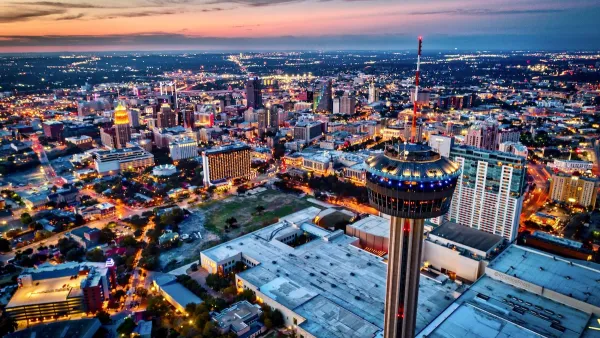
San Antonio and Austin are Fusing Into one Massive Megaregion
The region spanning the two central Texas cities is growing fast, posing challenges for local infrastructure and water supplies.

California High-Speed Rail's Plan to Right Itself
The railroad's new CEO thinks he can get the project back on track. The stars will need to align this summer.

Planetizen Federal Action Tracker
A weekly monitor of how Trump’s orders and actions are impacting planners and planning in America.

Amtrak, CN end decades-long dispute with eight-year agreement
The new operating agreement establishes an updated framework for the companies to work together, including processes to resolve disputes.

Judges permit Denver to divert 77,000 acre feet from the Colorado River for reservoir expansion
Overuse and climate change have caused the Colorado River’s water levels to plummet.

NYC DOT wants faster, more permanent street upgrades
The city is examining ways to build more concrete infrastructure without getting entangled in 'decades-long' projects.

'Something we’ve never seen before:' rising utility rates could strain city finances nationwide
Data centers, climate change and other factors have caused utility rates in the United States to increase by 38% since 2020.

Trump to overrule local leaders, lease millions of acres of America’s Pacific Island territories’ seafloors to mining companies
International law says that the Indigenous people of America’s territories have a right to prior and informed consent regarding projects that impact their countries.

FREE Course: Walkable City 1: Why Walkability?
After describing his path towards focusing on walkability as the essence of good planning, Jeff Speck marches through his five principal reasons for making more walkable places.
Reinventing Malls: Planning Alchemy—Turning Gray Fields Into Gold
The course focuses on the opportunities and imperatives that shape reinvention of mall sites.

Harvard University Graduate School of Design
KFH Group Inc.
Greater Baltimore Committee
The Architects Foundation
University of Cincinnati Online
The Pocatello Development Authority
The Urban Renewal Agency of the City of Pocatello

