Andy Lipkis, the founder and president of TreePeople, an organization in Los Angeles that brings natural concepts into the "urban forest", details his 40 years of work proving the feasibility of projects such as the Elmer Avenue Project.


The article features exclusive, in depth Q&A with Andy Lipkis, founder and president of TreePeople.
"My body of work up until now has been about proving feasibility where there have been significant barriers in the way of policy and funds. TreePeople has decided that it's time to step it up and catalyze a plan to retrofit all of Southern California on those principles-to make our region a functioning community forest."
"Most of our contributions rely on other people's innovations from other areas that were pulled together by us to do what's appropriate for Southern California. The street swale, for example, has been executed well in Seattle and Portland. In Seattle, it's called the SEA Streets (Street Edge Alternatives) Project. What's neat about this is that there's an ongoing, cross-pollination collaboration, because Seattle was forced to take this approach to restore salmon habitat throughout the city."
"We keep coming up against this. There are conceptual blocks. One is the belief that people won't change. Tim Brick, the outgoing head of MWD, worked very hard in his last couple of years. He brought in the Australians; he brought in stories of success. I don't understand why, even when the president of the board champions this approach, it hasn't stuck at the agencies. I can tell you my guess as to why: they're stuck in a command-and-control mode, where they might not appreciate that they can still have the same quality assurance and supply assurance through a distributed smart system."
Thanks to James Brasuell
Read the full story: TreePeople’s Urban Forest Principles Guide Retrofit of L.A.

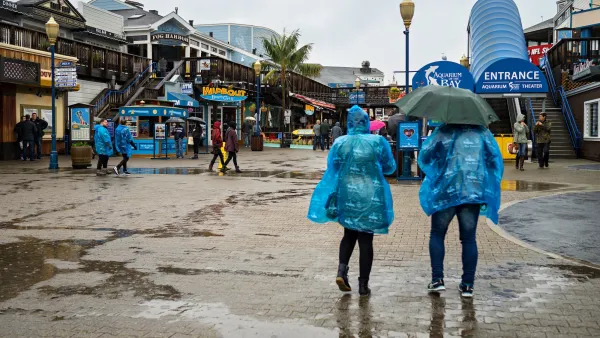
Rain gardens keep up to 99% of pollutants out of San Francisco Bay
The city's roadside rain gardens soak up stormwater and filter out dozens of harmful micropollutants.

California Lawmakers Move to Protect Waterways
Anticipating that the Trump EPA will reinstate a 2017 policy that excluded seasonal wetlands and waterways from environmental protections.

Public Parks as Climate Resilience Tools
Designed with green infrastructure, parks can mitigate flooding, reduce urban heat, and enhance climate resilience, offering cost-effective solutions to environmental challenges while benefiting communities.

Planetizen Federal Action Tracker
A weekly monitor of how Trump’s orders and actions are impacting planners and planning in America.

California plans to bury El Niño’s downpour
If the state plays its cards right, it may be able to store a billion acre-feet of El Niño’s water in aquifers.

Chicago breaks ground on $3 billion megadevelopment
The new neighborhood, titled Foundry Park, will one day host 3,700 residences.

California High-Speed Rail Authority CEO resigns after $600,000 scandal
Under Ian Choudri, the authority used taxpayer dollars to fund first class flights and trips to nightclubs.

Want to study the Missouri River? Soon, you may need unanimous approval from 10 states
Legislation would require 10 governors’ permission to study or build projects moving water outside the basin.

Desperate measures: Advocates weigh draining Lake Powell to fill Colorado River
Draining the reservoir could reduce evaporation losses by a couple hundred thousand acre-feet.

FREE Course: Walkable City 1: Why Walkability?
After describing his path towards focusing on walkability as the essence of good planning, Jeff Speck marches through his five principal reasons for making more walkable places.
Reinventing Malls: Planning Alchemy—Turning Gray Fields Into Gold
The course focuses on the opportunities and imperatives that shape reinvention of mall sites.

City of Rosemead
Rutgers University, Edward J. Bloustein School of Planning and Public Policy
One Hundred Miles
Hunter College, City University of New York (CUNY)
The Architects Foundation
University of Cincinnati Online
City of Cambridge
Montrose County
The Pocatello Development Authority