Christopher Leinberger argues that regardless of current coping strategies, the mortgage crisis is permanently reshaping cities and their edges.


Leinberger points to over-investment in metropolitan fringe areas as one of the root cause of the current crisis. Foreclosure moratoriums only delay the inevitable, he says, suggesting that housing values in most fringe neighborhoods will never return to their boom-time peaks. Such 'pretend and extend' policies simply encourage underwater homeowners to remain in economically crippled areas, contributing to long-term unemployment.
The result may be a reverse migration from exurban homesteads, Leinberger writes:
'The good news in this continuing mess is that there is substantial pent-up demand for higher density urban places, which will put a sustainable foundation under the U.S. economy similar to the foundation we enjoyed during the last half of the 20th century when we were building the drivable suburbs.'
Read the full story: Pretend and Extend--Our Mortgage Crisis Fantasy
Mortgage Modification Bad for Banks
James Surowiecki dispels the myth that banks are better off renegotiating mortgage then foreclosing.
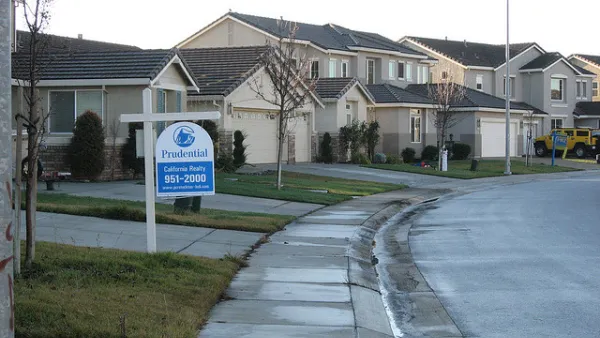
Subprime Loans Are Back—Now They're Called Nonprime Loans
Some say that "nonprime" loans will create the same financial ruins as their "subprime" predecessors. Others say the housing market needs ways for more people to buy homes and drive the industry.
The Last Days of the Home Affordable Modification Program
The Washington Post takes stock of the Home Affordable Modification Program (HAMP) in its final days, finding a program hampered by bad faith from large banks and bad oversight by the Treasury Department.

Planetizen Federal Action Tracker
A weekly monitor of how Trump’s orders and actions are impacting planners and planning in America.

California plans to bury El Niño’s downpour
If the state plays its cards right, it may be able to store a billion acre-feet of El Niño’s water in aquifers.

Desperate measures: Advocates weigh draining Lake Powell to fill Colorado River
Draining the reservoir could reduce evaporation losses by a couple hundred thousand acre-feet.

US buildings threatened, destroyed by fires set to triple by 2060
Researchers found a high fire risk for socioeconomically vulnerable neighborhoods in the American West.

LA residents may be allowed to paint their own crosswalks
Councilwoman Katy Yaroslavsky put out a motion instructing the Los Angeles Department of Public Transportation to study the feasibility of allowing volunteers to paint crosswalks.

Dallas moves to overhaul its zoning code
The city's zoning reform will allow more multi-family and mixed-use developments.

FREE Course: Walkable City 1: Why Walkability?
After describing his path towards focusing on walkability as the essence of good planning, Jeff Speck marches through his five principal reasons for making more walkable places.
Reinventing Malls: Planning Alchemy—Turning Gray Fields Into Gold
The course focuses on the opportunities and imperatives that shape reinvention of mall sites.

City of Rosemead
Rutgers University, Edward J. Bloustein School of Planning and Public Policy
One Hundred Miles
Hunter College, City University of New York (CUNY)
The Architects Foundation
University of Cincinnati Online
City of Cambridge
Montrose County
The Pocatello Development Authority