The newest U.S. stimulus proposal is aimed at improving infrastructure but could go farther, says Jonna McKone from TheCityFix.com.


McKone writes about the recent $50 Billion Infrastructure push from the White House:
"The most intriguing piece of President Obama's new plan to infuse the U.S. economy with jobs - by renewing roads, rail and air travel - is the proposed $50 billion dollar infrastructure bank. While not a new concept, the creation of an infrastructure bank would likely benefit the country's aging infrastructure. However, the plan lacks detail on the types of projects the proposal would fund and how the federal government would seek long-term payoffs for the improvements.
Ideally, the infrastructure bank should align with the proposed National Transportation Objectives Bill, which establishes national objectives, including: promoting energy efficiency and security, ensuring environmental protection and safety, improving economic competitiveness, and providing equal access to transportation. Other objectives include reducing per capita vehicle miles traveled by 16% and transportation-generated CO2 levels by 40%, as well as tripling walking, biking, and public transit use."
Thanks to Garrett Bradford
Read the full story: Obama’s Infrastructure Proposal: A Good Start That Needs Work
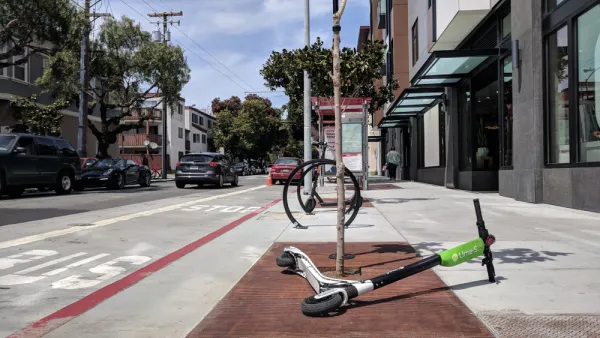
Op-Ed: Cities, Get the Scooters Under Control
Scooters are a useful addition to the mobility landscape, but cities need to address the many safety issues that come along with them.
Trails Win Big in Florida's 2015-16 State Budget
Florida Governor Rick Scott approved a $78 billion state budget last week, which includes $25 million for a statewide network of non-motorized trails.
Durham, NC Moving ahead with High-Profile Projects
Durham City Council members may be ready to take on new debt to fund a list of big-ticket parks and transportation projects which would help keep pace with growth and enhance the community.

Planetizen Federal Action Tracker
A weekly monitor of how Trump’s orders and actions are impacting planners and planning in America.

Eastern Nebraska is running out of electricity
Data centers and electrification are straining eastern Nebraska’s grid, throttling economic development.

Study reveals best places in the U.S. for cycling, walking
New research from Streetlight Data examines bicycle and pedestrian miles per capita in the 100 largest U.S. cities by population.

DSA members accuse Mamdani of 'abandoning values' over housing redevelopment
New York City's mayor plans to replace about 2,000 units of public housing with private, mixed-income housing.

All sides of BRT debate unhappy with CDOT’s most recent move
The Colorado Department of Transportation is no longer considering center-running bus lanes for Colorado Boulevard.

Massachusetts bogs generate both power, and cranberries
Putting solar panels above farmland is one way Massachusetts is advancing toward its goal of net-zero carbon emissions by 2050.

FREE Course: Walkable City 1: Why Walkability?
After describing his path towards focusing on walkability as the essence of good planning, Jeff Speck marches through his five principal reasons for making more walkable places.
Reinventing Malls: Planning Alchemy—Turning Gray Fields Into Gold
The course focuses on the opportunities and imperatives that shape reinvention of mall sites.

City of Rosemead
Rutgers University, Edward J. Bloustein School of Planning and Public Policy
One Hundred Miles
University of Michigan School for Environment and Sustainability (SEAS)
Hunter College, City University of New York (CUNY)
The Architects Foundation
City of Cambridge
The Pocatello Development Authority
The Urban Renewal Agency of the City of Pocatello