Drake Bennett rounds up a host of new ideas for cities like Detroit and Cleveland that are forced to consider how to manage their shrinking cities.


Bennett writes:
"The resulting cities may need to look and feel very different - different, perhaps, from the common understanding of what a modern American city is. Rather than trying to lure back residents or entice businesses to build on vacant lots, cities may be better off finding totally new uses for land: large-scale urban farms, or wind turbines or geothermal wells, or letting large patches revert to nature. Instead of merely tolerating the artist communities that often spring up in marginal neighborhoods, cities might actively encourage them to colonize and reshape whole swaths of the urban landscape. Or they might consider selling off portions to private companies to manage.
A few of these ideas are actually starting to be tried."
Cleveland, Detroit, and Lackawanna, New York are all discussed.
Read the full story: How to shrink a city

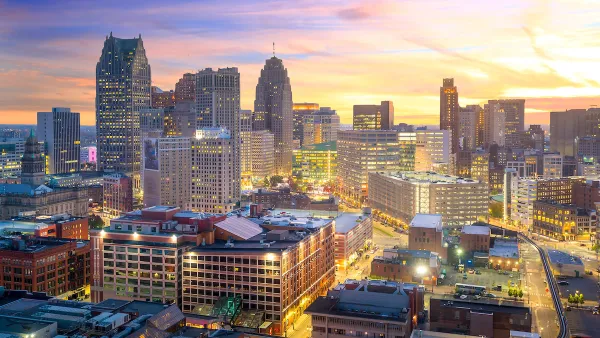
Detroit and Michigan on the Upswing
It's been 66 years since the Motor City last grew its population. Census data released last month revealed an increase of nearly 2,000 people last year, nearly half the state's population growth.
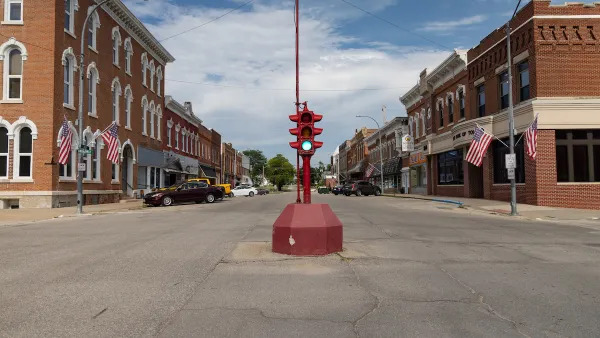
Iowa Towns Embrace a ‘Shrink Smart’ Approach
Population loss doesn’t have to be a harbinger of doom. Some rural communities are taking small but impactful steps to improve quality of life for their remaining residents.

'Supporting Shrinkage': Lessons for U.S. Cities
An excerpt from "Supporting Shrinkage: Better Planning and Decision-Making for Legacy Cities," written by Michael P. Johnson, Justin B. Hollander, Eliza W. Kinsey, and George R. Chichirau and published by SUNY Press.

Planetizen Federal Action Tracker
A weekly monitor of how Trump’s orders and actions are impacting planners and planning in America.

Northwest rail fans eager for Sept. 30 debut of Amtrak’s Airo fleet
Get ready for that new train smell and more seats. But they won’t go faster or run more frequently on the Cascades route in Washington and Oregon.

Trump is considering data centers on 6 states' public land — some state officials say they had no idea
If the administration approves the proposed projects, data center and data center-related developments will cover 17,600 acres of public land.

After decades of planning, Sacramento gains new light rail station
Trains will arrive every 15 minutes during peak hours and every 30 minutes during non-peak hours.

Massive tunnel-boring machine breaks ground on Gateway Project
The Trump administration revoked funding for the project in October 2025, and then restored it earlier this year.

Airo trainsets begin service on Amtrak Cascades route
The trains feature panoramic windows, complementary wifi and over 300 seats per train set.

FREE Course: Walkable City 1: Why Walkability?
After describing his path towards focusing on walkability as the essence of good planning, Jeff Speck marches through his five principal reasons for making more walkable places.
Reinventing Malls: Planning Alchemy—Turning Gray Fields Into Gold
The course focuses on the opportunities and imperatives that shape reinvention of mall sites.

City of Thousand Oaks
City of Wisconsin Rapids
Harvard University Graduate School of Design
The Architects Foundation
University of Cincinnati Online
Northern Illinois Transit Authority (NITA)
The Pocatello Development Authority
The Urban Renewal Agency of the City of Pocatello