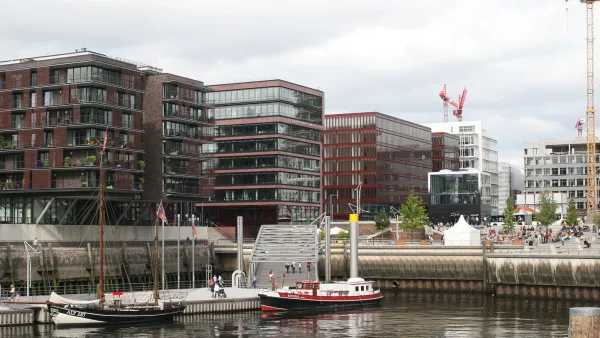
The new HafenCity district under construction in Hamburg, Germany, is one of the largest urban developments underway today. Some worry that its newness and bigness aren't prime conditions for harboring neighborliness.


Though the project won't be fully complete until 2025, parts of it are open and occupied -- but not exactly exuding small-town charm.
"Strolling through HafenCity on an overcast, late-summer evening is enough to make anyone feel the weight of such questions. It remains difficult to get here with several roads blocked by construction sites and taxis a rarity. During the day, a never-ending stream of trucks cause noisy, dusty traffic jams. While some in Hamburg are optimistic, calling the development "Hamburg's most beautiful construction site," others are less kind, referring to it as an "architectural zoo." For the moment, both are accurate. Many of the new structures are certainly aesthetically pleasing, but HafenCity does not feel like a city center. In fact, apart from a couple of lit windows and one or two pedestrians out with their dogs, it feels like nothing so much as an oversized ghost town."
Read the full story: The Challenge of Making HafenCity Feel Neighborly

Living With Flooding in a German Port Town
A riverside neighborhood in Hamburg embraces flooding as part of its resilience planning, using old techniques to protect modern communities.
Has Hamburg Mastered the Formula for Creating Urban Life?
In Germany's second largest city, a $14 billion experiment will prove whether planners and designers understand what it takes to breathe life into large scale urban redevelopments.

More Diesel Driving Bans Coming to German Cities
Germany's automotive industry and Chancellor Angela Merkel are increasingly worried about the economic effects of court-sanctioned diesel driving bans to improve air quality, as enacted in Hamburg last May. Four more cities are likely to enact bans.

Planetizen Federal Action Tracker
A weekly monitor of how Trump’s orders and actions are impacting planners and planning in America.

California plans to bury El Niño’s downpour
If the state plays its cards right, it may be able to store a billion acre-feet of El Niño’s water in aquifers.

Chicago breaks ground on $3 billion megadevelopment
The new neighborhood, titled Foundry Park, will one day host 3,700 residences.

California High-Speed Rail Authority CEO resigns after $600,000 scandal
Under Ian Choudri, the authority used taxpayer dollars to fund first class flights and trips to nightclubs.

Want to study the Missouri River? Soon, you may need unanimous approval from 10 states
Legislation would require 10 governors’ permission to study or build projects moving water outside the basin.

Desperate measures: Advocates weigh draining Lake Powell to fill Colorado River
Draining the reservoir could reduce evaporation losses by a couple hundred thousand acre-feet.

FREE Course: Walkable City 1: Why Walkability?
After describing his path towards focusing on walkability as the essence of good planning, Jeff Speck marches through his five principal reasons for making more walkable places.
Reinventing Malls: Planning Alchemy—Turning Gray Fields Into Gold
The course focuses on the opportunities and imperatives that shape reinvention of mall sites.

City of Rosemead
Rutgers University, Edward J. Bloustein School of Planning and Public Policy
One Hundred Miles
Hunter College, City University of New York (CUNY)
The Architects Foundation
University of Cincinnati Online
City of Cambridge
Montrose County
The Pocatello Development Authority