With rapid population growth in Indian cities and a rise in private car ownership, it is critical to reassess the role of auto-rickshaws in the urban transportation landscape, say Akshay Mani and Amit Bhatt.


Akshay Mani and Amit Bhatt are from the Centre for Sustainable Transport in India (CST-India). They say that promoting auto-rickshaws is a key part of developing an integrated public transport system and stalling the growth of private cars in India.
They write, "From a policy standpoint, there seems to be a lack of awareness about these issues in the eyes of public officials. Auto-rickshaws are seen as a mode of the past, with little or no role to play in the urban transportation landscape."
Thanks to Erica Schlaikjer
Read the full story: Why Auto-Rickshaws Matter for India

The Climate Story You Might Have Missed
Surface temperatures reached 60 degrees Celsius (140 degrees Fahrenheit) in India and Pakistan at the end of April. Wet bulb temperature, the point at which the human body can no longer cool itself by sweating, is 35 degrees Celsius.
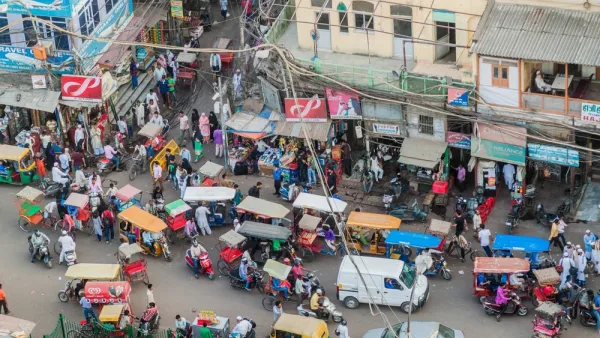
Experiencing Hyperdensity in Old Delhi
A tourist visit through the oldest, densest part of Delhi, India, reveals the chaos and beauty of hyperdensity.
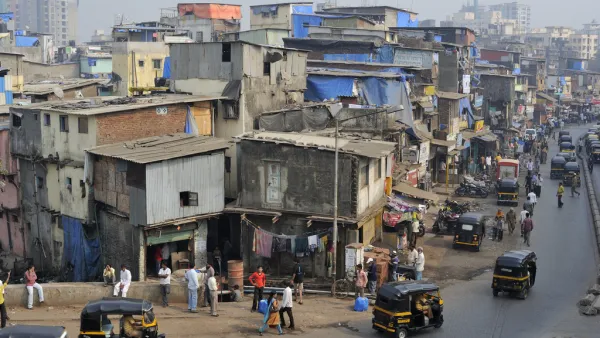
Are U.S. Homeless Worse Off Than India's Poor?
In photographs and written observations of a recent trip to Mumbai, India, former SPUR Director Jim Chappell queries how the lives of the poorest people there compare to the lives of low-income Americans.

Planetizen Federal Action Tracker
A weekly monitor of how Trump’s orders and actions are impacting planners and planning in America.

Eastern Nebraska is running out of electricity
Data centers and electrification are straining eastern Nebraska’s grid, throttling economic development.

Study reveals best places in the U.S. for cycling, walking
New research from Streetlight Data examines bicycle and pedestrian miles per capita in the 100 largest U.S. cities by population.

Federal government nominates new FTA administrator
Mark Aesch is currently the founder and CEO of a transportation management consulting firm.

Developers reveal $10 billion stadium plan as ‘Hail Mary’ to keep Bears in Chicago
The plan would also boast a public park, high- and mid-rise buildings and a youth sports complex.

As Texas embraces carbon storage, a Black community questions the risks
Texas now issues permits for companies to store carbon dioxide underground. East Texas residents fear safety risks, and skeptics doubt the climate benefits.

FREE Course: Walkable City 1: Why Walkability?
After describing his path towards focusing on walkability as the essence of good planning, Jeff Speck marches through his five principal reasons for making more walkable places.
Reinventing Malls: Planning Alchemy—Turning Gray Fields Into Gold
The course focuses on the opportunities and imperatives that shape reinvention of mall sites.

City of Charlotte
City of Rosemead
Rutgers University, Edward J. Bloustein School of Planning and Public Policy
University of Michigan School for Environment and Sustainability (SEAS)
Hunter College, City University of New York (CUNY)
The Architects Foundation
City of Cambridge
The Pocatello Development Authority
The Urban Renewal Agency of the City of Pocatello