Elgin Park is a small city that doesn't exist. But online, through a series of photographs created from tiny models in the house of one Massachusetts man, the time-frozen industrial town of the mid-'60s has come to life.


"The memories, and the images on the Flickr photo-sharing site, belong to Michael Paul Smith. They've made his town' a tourist destination, attracting about 20 million views, all arriving through cyberspace, since January.
You won't find Mr. Smith in Elgin Park - in a corporal sense, he resides in Winchester, Mass., just north of Boston - nor is the town on any map. It is not based on Elgin, Ill., or any other Elgin. Rather, Elgin Park is an imaginary melting pot of a steel mill town where the calendar is frozen at 1964.
Mr. Smith posted his first Elgin Park images about two years ago; for some time, they were attracting only about 200 views a day. For reasons that aren't entirely clear - someone in the Flickr community clicked on the slide show feature and then sent the link to others - the images began to spread virally in January. At times, daily page views approached 750,000, Mr. Smith said."
Using a series of die-cast model cars from the mid-20th Century and a skill with modelmaking, Smith has created a town.
Read the full story: Lots of Web Traffic in Such a Tiny Town
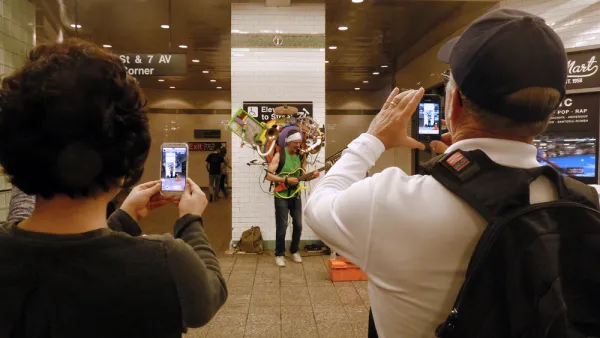
Friday Eye Candy: The Theatricality of the Subway
A new book of photography amplifies what was already there.
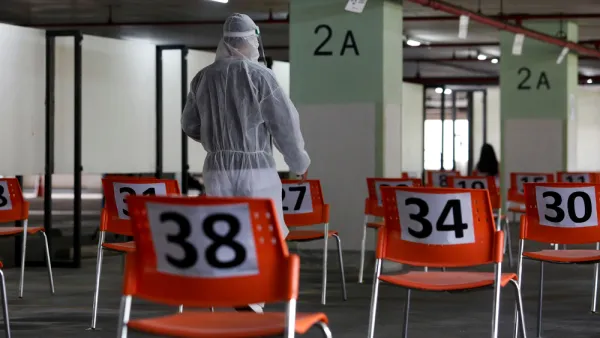
Second Wave or Second Peak?
The terminology of the coronavirus pandemic isn't applied consistently, particularly when dealing with areas seeing a resurgence of infection after states have relaxed social distancing restrictions. The World Health Organization added some clarity.

Study: 36,000 American Lives Would Have Been Saved if White House Acted One Week Earlier
Research from Columbia University Mailman School of Public Health looks at the timing of the imposition of public health control measures, at the start of the pandemic and in the present if infections increase, to project lives saved or lost.

Desperate measures: Advocates weigh draining Lake Powell to fill Colorado River
Draining the reservoir could reduce evaporation losses by a couple hundred thousand acre-feet.

Eastern Nebraska is running out of electricity
Data centers and electrification are straining eastern Nebraska’s grid, throttling economic development.

Malls are becoming the midtowns of the future
Mall and office park redevelopments are a generational opportunity to create new nodes of urbanity.

NYC breaks ground on anti-flooding infrastructure project
New York City's new system will reduce stormwater flows to local sewers by 90%.

One Kentucky town’s secret to affordable housing
The Smoketown Community Land Trust has already built seven affordable homes for community members.

Houston gains petal-shaped cooling infrastructure to make streets more ‘delightful’
The city has installed the pavilions along 15 blocks in Houston.

FREE Course: Walkable City 1: Why Walkability?
After describing his path towards focusing on walkability as the essence of good planning, Jeff Speck marches through his five principal reasons for making more walkable places.
Reinventing Malls: Planning Alchemy—Turning Gray Fields Into Gold
The course focuses on the opportunities and imperatives that shape reinvention of mall sites.

City of Rosemead
Rutgers University, Edward J. Bloustein School of Planning and Public Policy
One Hundred Miles
University of Michigan School for Environment and Sustainability (SEAS)
Hunter College, City University of New York (CUNY)
The Architects Foundation
City of Cambridge
Montrose County
The Pocatello Development Authority