Last year I had the opportunity to teach a graduate course on "Web 2.0 for Policy and Planning" at the University of Southern California's School of Policy, Planning & Development. Although I am co-teaching a different class this year, I have updated my course website with a revised course syllabus and extensive reading list on Web 2.0 and planning, based on what I learned from teaching the course in Spring, 2009.


Last year I had the opportunity to teach a graduate course on "Web 2.0 for Policy and Planning" at the University of Southern California's School of Policy, Planning & Development.
Although I am co-teaching a different class this year, I have updated my
course website with a revised course syllabus and extensive reading list on Web 2.0 and planning, based on what I learned
from teaching the course in Spring, 2009.
Each student selected a particular Web 2.0 technology and examined the technology through a planning or urban policy lense. I selected the best six student white papers from the
course, and have now assembled them in a short book, Exploring Web 2.0
in Urban Planning.
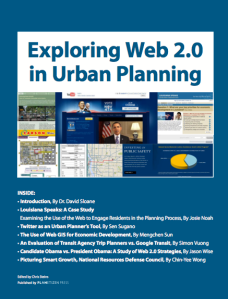 Exploring Web 2.0 in Urban Planning
A collection of six white papers,
Edited by Chris Steins | Published by Planetizen Press
Abstract: Emerging technologies are fundamentally changing how we
plan, develop and manage our urban areas. Likewise, planning
professionals are increasingly being called on to adopt new
technologies to plan, communicate planning concepts and engage citizens
in the planning process. This collection of articles introduces a range
of Web 2.0 technologies that can be applied to the field of planning,
including Web surveys, Twitter, Web-based geographic information
systems, Google transit, citizen engagement strategies, and image
visualizations. The six white papers in this document were researched
and written by authors at the School of Policy, Planning, and
Development University of Southern California as part of a Spring, 2009
graduate- level course on Internet Technologies and Urban Planning.
Contents
- Introduction, By Dr. David Slaone
- Louisiana Speaks: A Case Study: Examining the Use of the Web to Engage Residents in the Planning Process, By Josie Noah
- Twitter as an Urban Planner's Tool, By Sen Sugano
- The Use of Web GIS for Economic Development, By Mengchen Sun
- An Evaluation of Transit Agency Trip Planners vs. Google Transit, By Simon Vuong
- Candidate Obama vs. President Obama: A Study of Web 2.0 Strategies, By Jason Wise
- Picturing Smart Growth, National Resources Defense Council, By Chin-Yee Wong
The book is available for free to download (PDF), or
available in printed form for a modest printing fee (Ordering information is at the bottom of the linked page.)


Planetizen Federal Action Tracker
A weekly monitor of how Trump’s orders and actions are impacting planners and planning in America.

Amtrak, CN end decades-long dispute with eight-year agreement
The new operating agreement establishes an updated framework for the companies to work together, including processes to resolve disputes.

Northwest rail fans eager for Sept. 30 debut of Amtrak’s Airo fleet
Get ready for that new train smell and more seats. But they won’t go faster or run more frequently on the Cascades route in Washington and Oregon.

Trump administration unlawfully slashed $7 billion in clean energy grants, judge rules
The Environmental Protection Agency ended the Solar For All program, which provided the grants, after President Donald Trump’s inauguration.

Record-breaking wildlife overpass in Colorado brings 91% reduction in animal collisions
Prior to the overpass, vehicles were hitting one deer per day on Colorado’s Interstate 25.

California lawmakers approve just 5% of much-needed LA28 transportation funding
State legislators appear just as unwilling as Trump to pay for Olympics-related transportation projects.

FREE Course: Walkable City 1: Why Walkability?
After describing his path towards focusing on walkability as the essence of good planning, Jeff Speck marches through his five principal reasons for making more walkable places.
Reinventing Malls: Planning Alchemy—Turning Gray Fields Into Gold
The course focuses on the opportunities and imperatives that shape reinvention of mall sites.

City of Thousand Oaks
City of Wisconsin Rapids
Harvard University Graduate School of Design
The Architects Foundation
University of Cincinnati Online
The Pocatello Development Authority
The Urban Renewal Agency of the City of Pocatello

