A radio interview in Chicago talks about the merits of street food and the historical reasons for restrictions on vendors.


"INTERVIEWER: Why do we outlaw street vendors in Chicago?
INTERVIEWEE: One, we have a very powerful restaurant lobby that did a lot to shoot down the smoking ban, if you recall a few years back and put that off for several years. And obviously they don't want the competition on their doorstep. I also think historically it's wrapped up in anti-immigrant sentiment. Historically, people looked down on Italians or Greeks were eating, and it was one thing for them to be eating their strange olive oil and garlic in their house, but it was another thing for them to be eating it right in front of us."
Read the full story: Extension 720 Unabridged - 01/20/10 - Bruce Craig, Monica Eng and Dan Protess
The Growing Food Truck Industrial Complex
The food truck phenomenon is here to stay and stimulating tangential industries that include truck outfitters, permit expediters, lawyers lobbyists, website designers, and marketing professionals.
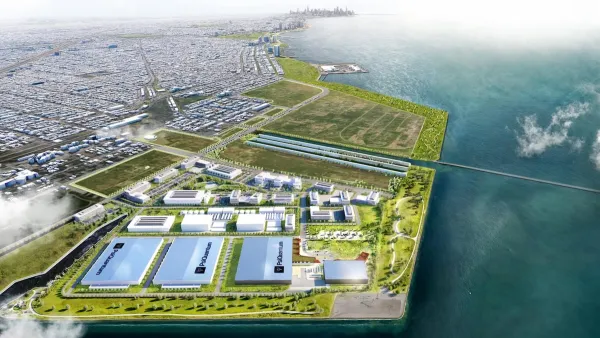
Illinois considers spending $1 billion in taxpayer money on data center
A quantum computing campus and data center are currently under construction in Chicago.

Chicago cuts ribbon on $300,000, self-cleaning public toilet
The public toilet is the city’s first, and may pave the way for a rollout of similar facilities.

Planetizen Federal Action Tracker
A weekly monitor of how Trump’s orders and actions are impacting planners and planning in America.

Eastern Nebraska is running out of electricity
Data centers and electrification are straining eastern Nebraska’s grid, throttling economic development.

Washington state to charge fee to drivers with fuel-efficient cars
Revenue from the fee will go towards supporting the state’s highways.

Instead of building new housing, LA developers are turning mansions into mega-mansions
In the richest areas, the number of houses valued at $30 million with demolition permits has skyrocketed since 2018.

Illinois considers spending $1 billion in taxpayer money on data center
A quantum computing campus and data center are currently under construction in Chicago.

As development costs rise, Boston moves to lessen affordable housing requirements
The Boston Zoning Commission and the City Council still need to approve Boston Mayor Michelle Wu’s proposed changes

FREE Course: Walkable City 1: Why Walkability?
After describing his path towards focusing on walkability as the essence of good planning, Jeff Speck marches through his five principal reasons for making more walkable places.
Reinventing Malls: Planning Alchemy—Turning Gray Fields Into Gold
The course focuses on the opportunities and imperatives that shape reinvention of mall sites.

City of Charlotte
City of Rosemead
Rutgers University, Edward J. Bloustein School of Planning and Public Policy
University of Michigan School for Environment and Sustainability (SEAS)
Hunter College, City University of New York (CUNY)
The Architects Foundation
City of Cambridge
The Pocatello Development Authority
The Urban Renewal Agency of the City of Pocatello