While in Copenhagen for climate talks in December, U.S. officials got a taste of Danish-style bicycle planning. Some of them liked what they saw, but translating that infrastructure here in the States is no easy task.


This post from Miller-McCune looks at the prospects and challenges of recasting American street infrastructure as a multi-modal platform.
"'Unfortunately, the existing built environment isn't helping us,' California Air Resources Board Chairwoman Mary Nichols said, 'and it makes it much more difficult and expensive to meet those goals.'
This isn't just a matter of engineering lithium-ion electric car batteries, but re-engineering whole communities. If you live in certain urban areas, you may have seen a prototype: the trendy mixed-use development arisen out of an abandoned industrial complex complete with condos, restaurants and metro access
Advocates of "transit-oriented development" stress, though, that they're not just talking about Starbucks on the ground floor and yuppies up above."
FULL STORY: These Streets Weren’t Made for Walkin’

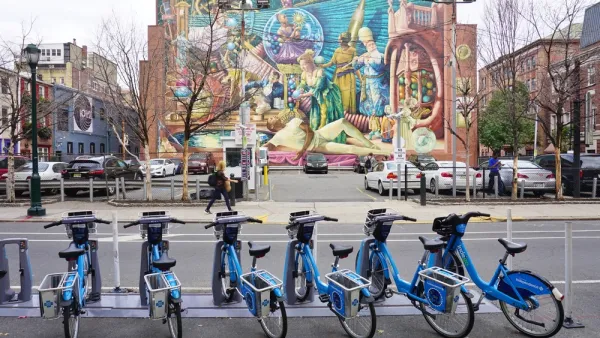
Checking in on Philadelphia's Promised Protected Bike Lanes
Philadelphia Mayor Jim Kinney is discovering on the job that planning is much easier than delivering when it comes to protected bike lanes—as is the case in many cities around the country.
Wanted: Six Cities Yearning to be Bike Friendlier!
For cities that want protected bike lanes but lack the expertise to implement them, the Green Lane Project is soliciting applications to offer technical help (sorry, no funding) now that the initial six recipient cities have implemented cycle tracks.
How Protected Bike Lanes Benefit Businesses
Can your city afford not to install protected bike lanes? Michael Andersen previews a coming report from the bike lane advocacy organization Green Lane Project and the Alliance for Biking and Walking that shows how such lanes help local businesses.

Planetizen Federal Action Tracker
A weekly monitor of how Trump’s orders and actions are impacting planners and planning in America.

The state-sanctioned urbicide of Austin
People don’t kill cities. Freeways do.

US to reduce Colorado River water deliveries to Mexico
A new Colorado Treaty amendment reduces Mexico’s Colorado River water allocation by 250,000 acre feet.

5 New England states march closer to 800 megawatt wind energy project
Securing federal approval for the project may be complicated under the Trump administration, which has historically been hostile towards domestic wind power.

Baltimore to break ground on $50 million Transit Priority Project
The project will bring faster bus trips, safer streets and better bike connections to Baltimore.

Airbnb launches $250 million 'last-dollar financing' housing accelerator, makes first investment in Austin
The company will put $6.4 million towards affordable housing development in Texas’ capital.

FREE Course: Walkable City 1: Why Walkability?
After describing his path towards focusing on walkability as the essence of good planning, Jeff Speck marches through his five principal reasons for making more walkable places.
Reinventing Malls: Planning Alchemy—Turning Gray Fields Into Gold
The course focuses on the opportunities and imperatives that shape reinvention of mall sites.

Eagle County Government
Harvard University Graduate School of Design
Nashville Planning Department
The Architects Foundation
University of Cincinnati Online
The Pocatello Development Authority
The Urban Renewal Agency of the City of Pocatello
Journal of the American Planning Association