After decades of auto-dependence, the French city of Strasbourg turned its back to the car and built a citywide tram system and street grid that reclaims roads from auto-dominance.


"Just like most American cities, the car's midcentury domination had largely forced public transportation out of Strasbourg. The once-extensive tram lines fell into disrepair, and the last one was taken out of service in 1960. But by 1989 traffic and parking had become major headaches for residents and for businesses in the dense warren of downtown streets. Rather than see retail flee to suburban malls, as it did in America, the city decided to take action.
This being France, where the entire political spectrum is to America's left, the conservatives running for city council in 1989 actually favored building a subway. But the socialists, led by Catherine Trautmann and Roland Ries, wanted to build a new tram. Conservatives and local business owners objected, arguing that a tram would take precious lanes away from cars. But that was exactly the point: to transform streets from hectic, unpleasant gasoline alleys into vibrant, multi-use communal spaces."
Read the full story: The French Revolution

The Future of Transit, According to France
Yonah Freemark investigates France's new love affair with the tram, which is spreading like wildfire in cities across the country, supplanting major bus routes and giving transit ridership a healthy boost in the process.
Guerrilla Crosswalk Debuts in France
Jeroen Beekmans reports on the pet project of "urban hacktivist" Florian Rivière to produce light-weight pop-up crosswalks.
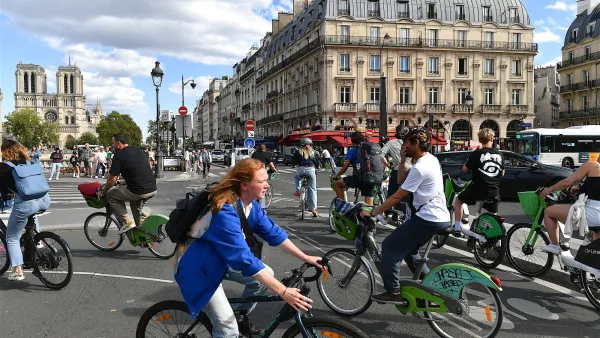
Biking in Paris grew by 240% in 5 years
The city saw a significant rise in bike use thanks to data-driven policy changes.

Planetizen Federal Action Tracker
A weekly monitor of how Trump’s orders and actions are impacting planners and planning in America.

Amtrak, CN end decades-long dispute with eight-year agreement
The new operating agreement establishes an updated framework for the companies to work together, including processes to resolve disputes.

Judges permit Denver to divert 77,000 acre feet from the Colorado River for reservoir expansion
Overuse and climate change have caused the Colorado River’s water levels to plummet.

NYC DOT wants faster, more permanent street upgrades
The city is examining ways to build more concrete infrastructure without getting entangled in 'decades-long' projects.

'Something we’ve never seen before:' rising utility rates could strain city finances nationwide
Data centers, climate change and other factors have caused utility rates in the United States to increase by 38% since 2020.

Trump to overrule local leaders, lease millions of acres of America’s Pacific Island territories’ seafloors to mining companies
International law says that the Indigenous people of America’s territories have a right to prior and informed consent regarding projects that impact their countries.

FREE Course: Walkable City 1: Why Walkability?
After describing his path towards focusing on walkability as the essence of good planning, Jeff Speck marches through his five principal reasons for making more walkable places.
Reinventing Malls: Planning Alchemy—Turning Gray Fields Into Gold
The course focuses on the opportunities and imperatives that shape reinvention of mall sites.

Harvard University Graduate School of Design
KFH Group Inc.
Greater Baltimore Committee
The Architects Foundation
University of Cincinnati Online
The Pocatello Development Authority
The Urban Renewal Agency of the City of Pocatello