Atlantic correspondent Cristine Russell takes a look at Mexico City's quickly-implemented bus rapid transit system.


Mayor Marcelo Ebrard has plans to expand the system to ten lines by 2012.
"Metrobús also offers a remarkable example of how to put a new transport system into place in a relatively short time, how to foster cooperation over competition in a city known for its rough-and-tumble politics, and how to create a public-private transport system that does not rely on massive public subsidies. In other words, not business as usual.
...In 2005, a mere three years after planning began, clean, energy-efficient, high-capacity buses began carrying passengers down dedicated bus lanes on Avenida de los Insurgentes, the city's main north-to-south traffic artery and one of the world's longest urban avenues. Since then, expansion of the Insurgentes line and the addition of a second line has resulted in about 450,000 passengers each day riding buses running on clean-burning ultra low sulfur diesel fuel along routes currently totaling 51 kilometers (about 32 miles)."
Read the full story: Take the Metrobús in Mexico City

New Report Explores the Benefits of BRT
By synthesizing existing literature and utilizing four detailed case studies, a new report from EMBARQ explores how bus rapid transit can impact the quality of life, productivity, health, and safety of city residents.
New Transit Systems of 2010
Garrett Bradford of TheCityFix reviews some of the most innovative and sustainable transit systems from around the globe that made their debut over the last twelve months.
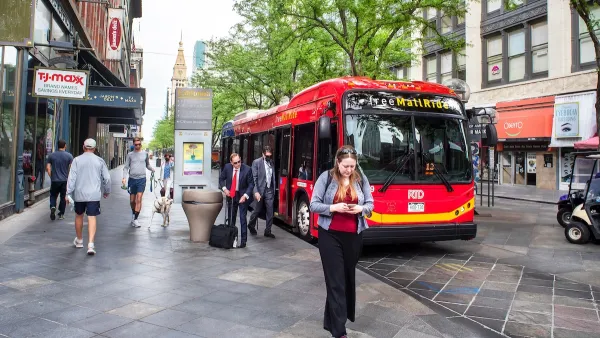
One of Denver’s busiest corridors to gain BRT
The project will span 18 miles and contain 74 bus rapid transit stations.

Planetizen Federal Action Tracker
A weekly monitor of how Trump’s orders and actions are impacting planners and planning in America.

California plans to bury El Niño’s downpour
If the state plays its cards right, it may be able to store a billion acre-feet of El Niño’s water in aquifers.

Chicago breaks ground on $3 billion megadevelopment
The new neighborhood, titled Foundry Park, will one day host 3,700 residences.

One of Denver’s busiest corridors to gain BRT
The project will span 18 miles and contain 74 bus rapid transit stations.

275,000 bus trips are at stake on Seattle's ballot
If passed, the Seattle Transit Measure would trigger a 0.3% sales tax and raise an average of $138 million per year to maintain and expand Seattle’s bus services.

Texas may pay Israeli company billions to ease water woes
Texas awarded IDE Technologies the contract for its Harbor Island project, which is slated to become the Western Hemisphere's largest desalination plant.

FREE Course: Walkable City 1: Why Walkability?
After describing his path towards focusing on walkability as the essence of good planning, Jeff Speck marches through his five principal reasons for making more walkable places.
Reinventing Malls: Planning Alchemy—Turning Gray Fields Into Gold
The course focuses on the opportunities and imperatives that shape reinvention of mall sites.

City of Rosemead
Rutgers University, Edward J. Bloustein School of Planning and Public Policy
One Hundred Miles
Hunter College, City University of New York (CUNY)
The Architects Foundation
University of Cincinnati Online
City of Cambridge
Montrose County
The Pocatello Development Authority