The city of St. Louis has been testing out a new sustainable streetscape design that calms traffic and helps absorb stormwater. The test run has been so well-received, the city is thinking about rolling out the design permanently.


The 30-day test is likely to become the new model for the city's street designs.
"The new design reduces four traffic lanes to three, changes the timing of traffic lights, adds curb 'bulb-outs' to reduce the amount of yardage pedestrians need to cross from 56 to 40 feet, and increases lighting and landscaping. About $2.7 million in federal stimulus funds have been awarded for the work.
'The goal is to have 50 percent of the new sections porous surfacing or plantings,' Culbertson said. 'If we do that, then the majority of the water that falls will actually percolate into the ground.' St. Louis has a combined sewage-stormwater system, which can be overwhelmed during downpours."
Read the full story: Sustainable Streetscape

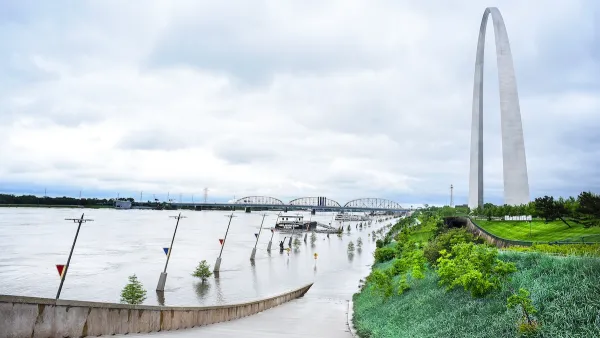
St. Louis has a Secret Stormwater Weapon Saving 100 Million Gallons from the Mississippi
The city reimburses residents who install gardens, rain barrels, and other methods that retain stormwater and decrease the risk of flooding.
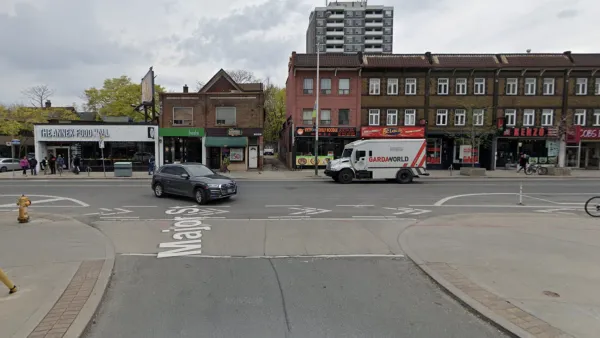
The Billion-Year-Old Curb Bulbout
Bloor Street didn't land on this billion-year old rock; the rock landed on Bloor Street.
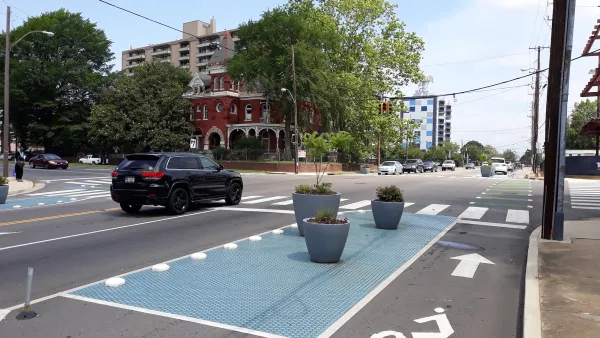
Memphis Street Goes on a Road Diet
Separated bike lanes and new pedestrian infrastructure have replaced traffic lanes on a mile of Manassas Street in Memphis.

Planetizen Federal Action Tracker
A weekly monitor of how Trump’s orders and actions are impacting planners and planning in America.

Amtrak, CN end decades-long dispute with eight-year agreement
The new operating agreement establishes an updated framework for the companies to work together, including processes to resolve disputes.

Judges permit Denver to divert 77,000 acre feet from the Colorado River for reservoir expansion
Overuse and climate change have caused the Colorado River’s water levels to plummet.

NYC DOT wants faster, more permanent street upgrades
The city is examining ways to build more concrete infrastructure without getting entangled in 'decades-long' projects.

'Something we’ve never seen before:' rising utility rates could strain city finances nationwide
Data centers, climate change and other factors have caused utility rates in the United States to increase by 38% since 2020.

Trump to overrule local leaders, lease millions of acres of America’s Pacific Island territories’ seafloors to mining companies
International law says that the Indigenous people of America’s territories have a right to prior and informed consent regarding projects that impact their countries.

FREE Course: Walkable City 1: Why Walkability?
After describing his path towards focusing on walkability as the essence of good planning, Jeff Speck marches through his five principal reasons for making more walkable places.
Reinventing Malls: Planning Alchemy—Turning Gray Fields Into Gold
The course focuses on the opportunities and imperatives that shape reinvention of mall sites.

Harvard University Graduate School of Design
KFH Group Inc.
Greater Baltimore Committee
The Architects Foundation
University of Cincinnati Online
The Pocatello Development Authority
The Urban Renewal Agency of the City of Pocatello