Having fallen to near-bottom according to most indicators of urban vitality, Detroit is now facing the possibility of bankruptcy. But there are still reasons for optimism, writes John Ibbitson.


Although the number of vacant homes in Detroit has doubled since 2005 and the crime rate is the worst in the nation, Michigan still has billions of dollars of investment flowing in from the government and private foundations financing research in new technologies at state universities in Detroit, Ann Arbor and Lansing. As well,
"Michigan remains a global leader in automotive-technology research, with a large pool of highly skilled engineers. The challenge is to use that resource to reinvent America's manufacturing base, and to make sure that enough of the jobs that flow from that reinvention remain in Michigan to restore the state's economy, along with a more confident sense of its future."
The goal must be to diversify Michigan's economy, especially by investing in renewable energy, something Ibbitsen believes the Canadian province of Ontario should be emulating.
Read the full story: Detroit is in crisis, but it hasn't given up
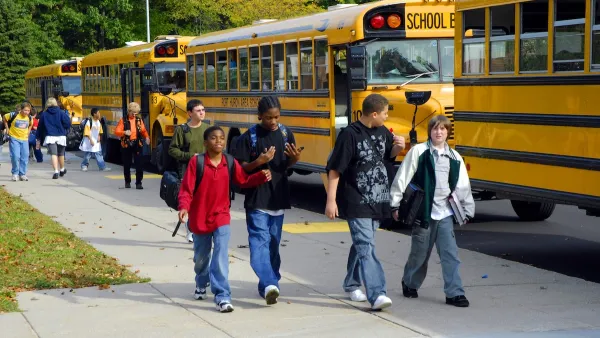
Learning loss and urban schools, part 2
Did test scores in progressive cities drop more post-COVID than test scores in moderate ones?
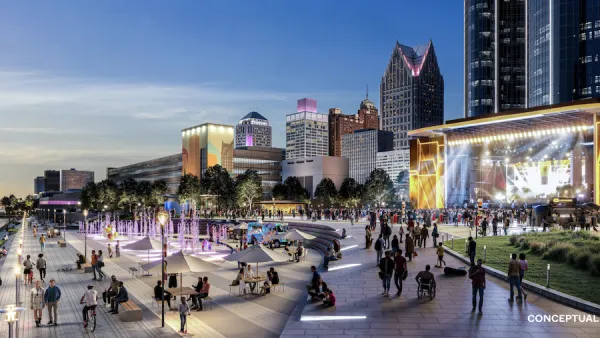
Detroit to transform waterfront with $2.2 billion investment
Developers will convert about 18 acres of unused parking lot space into civic spaces.
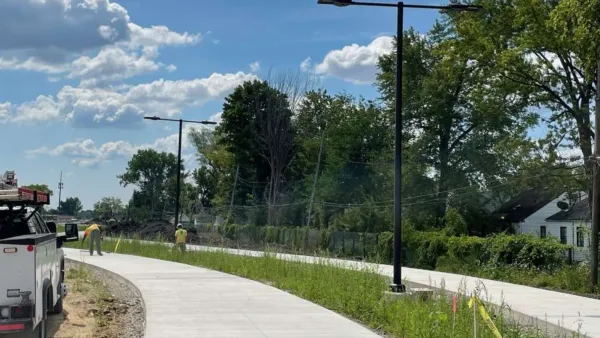
Detroit greenway brings revival — and fears of displacement
The planned Joe Louis Greenway is already bringing change to the neighborhoods near it.

Planetizen Federal Action Tracker
A weekly monitor of how Trump’s orders and actions are impacting planners and planning in America.

California plans to bury El Niño’s downpour
If the state plays its cards right, it may be able to store a billion acre-feet of El Niño’s water in aquifers.

Desperate measures: Advocates weigh draining Lake Powell to fill Colorado River
Draining the reservoir could reduce evaporation losses by a couple hundred thousand acre-feet.

In Texas, data centers are swallowing promised parkland
Residents who moved to Taylor, Texas for a rural community now have to contend with three data centers in their backyard.

How a Chicago-sized wind farm beat the odds and powered on
The project spanned five presidential administrations and a standoff with a U.S. military base.

MTA gives itself 30 days to transform pit into basketball court
The site has been under construction since 2022; the city originally estimated it would finish the court in 2024.

FREE Course: Walkable City 1: Why Walkability?
After describing his path towards focusing on walkability as the essence of good planning, Jeff Speck marches through his five principal reasons for making more walkable places.
Reinventing Malls: Planning Alchemy—Turning Gray Fields Into Gold
The course focuses on the opportunities and imperatives that shape reinvention of mall sites.

City of Rosemead
Rutgers University, Edward J. Bloustein School of Planning and Public Policy
One Hundred Miles
Hunter College, City University of New York (CUNY)
The Architects Foundation
University of Cincinnati Online
City of Cambridge
Montrose County
The Pocatello Development Authority