Steve Mouzon explains how to think about cities and towns as living species, and how that perspective should guide the practice of planners and architects.


"Urbanism is analogous to life in many ways. That is to say, a city is not a living creature, a city is like a living creature in useful ways. Types of settlements are similar to distinct species. A farming hamlet, for example, is far different from a metropolitan borough on many counts. They have far different habitats, food sources, life cycles, metabolic rates, waste materials, and appearances. So if types of settlements are like distinct species, then a particular city, town, village, or hamlet is like a single creature, and individual buildings within the city, town, village, or hamlet is like individual cells within the creature."
Read the full story: A Living Urbanism

Picture It: Coding for Character
Get lost in the details when explaining zoning reform? Hazel Borys puts forth a pictorial review that helps.
What Drives People?
Hazel Borys argues that "the payback of livable places really can’t be calculated in dollars, or pounds of fat or carbon, or even hours. The payback of place is passion."
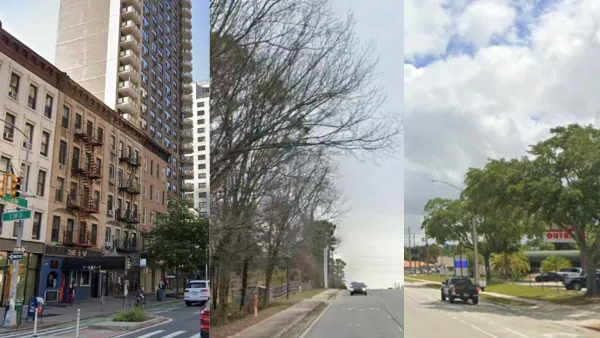
A Transect of sprawl
A development pattern this lifestyle-defining deserves its whole own classification system.

Planetizen Federal Action Tracker
A weekly monitor of how Trump’s orders and actions are impacting planners and planning in America.

Amtrak, CN end decades-long dispute with eight-year agreement
The new operating agreement establishes an updated framework for the companies to work together, including processes to resolve disputes.

Northwest rail fans eager for Sept. 30 debut of Amtrak’s Airo fleet
Get ready for that new train smell and more seats. But they won’t go faster or run more frequently on the Cascades route in Washington and Oregon.

St. Louis Metro to test if single-car trains can reduce operating costs, maintain rider satisfaction
The pilot program will run from October to spring 2027, and begin with one single-car train operating on Metrolink’s Red and Blue lines.

Pennsylvania is building data centers in abandoned mines
Housing data centers in mines provides an alternative to destroying local forests and may spare residents from data centers’ noise and air pollution.

If Corpus Christi can’t revive desalination plant project, it may owe Texas $235 million
Earlier this month, city officials declined to pursue developing the plant for the second time in a year.

FREE Course: Walkable City 1: Why Walkability?
After describing his path towards focusing on walkability as the essence of good planning, Jeff Speck marches through his five principal reasons for making more walkable places.
Reinventing Malls: Planning Alchemy—Turning Gray Fields Into Gold
The course focuses on the opportunities and imperatives that shape reinvention of mall sites.

City of Thousand Oaks
City of Wisconsin Rapids
Harvard University Graduate School of Design
The Architects Foundation
University of Cincinnati Online
The Pocatello Development Authority
The Urban Renewal Agency of the City of Pocatello