This profile from Miller-McCune looks at a Berkeley, California official who made use of a 100-year old funding mechanism to take the city solar.


When trying to figure out how to convert his home to solar power, Francisco DeVries found that, despite the long-term savings, dropping the initial money was a daunting prospect. In an effort to help fellow homeowners handle those costs, he found a way for the city to make the conversion easier -- by using municipal bonds to build up the capital costs of converting homes to solar power.
"Despite California's reputation for all things green, less than 0.5 percent of homes in the state have photovoltaic systems. Berkeley's greenhouse gas-reduction program is, in large part, aimed at encouraging the city's homeowners to put solar panels on their roofs. Because DeVries was in charge of spearheading the initiative, he says, 'I thought I should walk the walk: I thought I should get solar on my own house.'
But when he knuckled down to the task, DeVries came face-to-face with the high cost of going green. 'The bids came in, and I couldn't pull the trigger for all the same reasons that people everywhere aren't pulling the trigger,' he says. 'Which is, 'Oh my lord, that's a big check.''"
Read the full story: Solar System


28 States and DC Could Legalize ‘Balcony Solar’
Plug-in solar panels, which are becoming popular across Europe, live in a regulatory gray area in the United States.
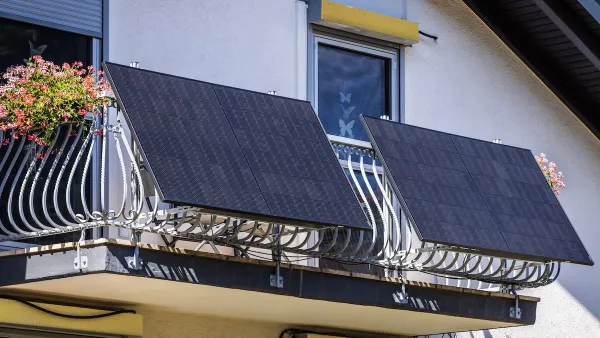
Bay Area Embraces ‘Balcony Solar’
Popular in Germany, wall- or balcony-mounted solar panels come at a lower cost and face fewer regulatory hurdles than rooftop solar, but their legal status in California is murky.

California Leads in Solar Rooftops
A combination of state and local incentives and building code mandates has helped California far outpace other states in residential rooftop solar permits.

Planetizen Federal Action Tracker
A weekly monitor of how Trump’s orders and actions are impacting planners and planning in America.

California plans to bury El Niño’s downpour
If the state plays its cards right, it may be able to store a billion acre-feet of El Niño’s water in aquifers.

Chicago breaks ground on $3 billion megadevelopment
The new neighborhood, titled Foundry Park, will one day host 3,700 residences.

One of Denver’s busiest corridors to gain BRT
The project will span 18 miles and contain 74 bus rapid transit stations.

275,000 bus trips are at stake on Seattle's ballot
If passed, the Seattle Transit Measure would trigger a 0.3% sales tax and raise an average of $138 million per year to maintain and expand Seattle’s bus services.

Texas may pay Israeli company billions to ease water woes
Texas awarded IDE Technologies the contract for its Harbor Island project, which is slated to become the Western Hemisphere's largest desalination plant.

FREE Course: Walkable City 1: Why Walkability?
After describing his path towards focusing on walkability as the essence of good planning, Jeff Speck marches through his five principal reasons for making more walkable places.
Reinventing Malls: Planning Alchemy—Turning Gray Fields Into Gold
The course focuses on the opportunities and imperatives that shape reinvention of mall sites.

City of Rosemead
Rutgers University, Edward J. Bloustein School of Planning and Public Policy
One Hundred Miles
Hunter College, City University of New York (CUNY)
The Architects Foundation
University of Cincinnati Online
City of Cambridge
Montrose County
The Pocatello Development Authority