At PieLab in Greensboro, Alabama, locals mingle with designers attempting to do use design to do good, with a slice of pie on the side.


The space is used as a headquarters for Project M- a small group of creatives are selected every year as part of the project team to travel to different locations, identify a problem, and solve it.
"On May 1 of this year, Brian Jones was among the group of four designers who arrived in Alabama after attending an M Blitz in Maine during the month of March that launched a movement called Free Pie. "Free Pie was designed to gather people together with pie in an effort to promote conversations with neighbors and strangers, and to bring humanity back into downtown areas," he says. "We used real plates and utensils from a thrift store to reduce waste and to encourage everyone to hang around and talk." It created such a successful, instant community for the small town, they decided to continue the experiment in Alabama, where a new group of designers would be arriving in June for a month-long session."
Read the full story: PieLab in Rural Alabama Serves Up Community, Understanding, and, Yes, Pie
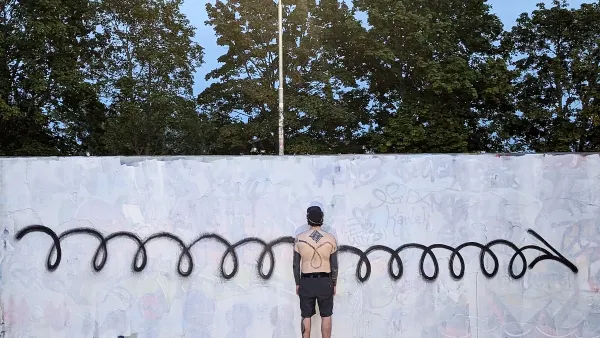
“Skin, Like a City, Will Tell You if You’ve Ignored its History”
Once an urban planner, Sean Colgrave traded in infrastructure for ink when he became a tattoo artist. Now he says: one profession has a lot to learn from the other.

These Bear Safety Signs Illustrate the Impact of Good Design
What makes a sign effective?
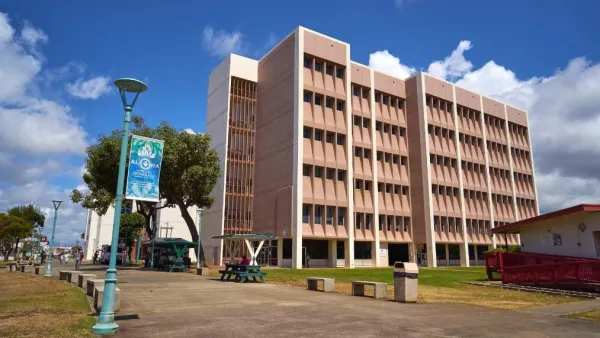
Expanding Access to Design Education at Honolulu Community College
Honolulu Community College’s Architecture, Engineering & Construction Technologies program highlights the role of community colleges in preparing nontraditional students for careers in architectural and construction technologies.

Planetizen Federal Action Tracker
A weekly monitor of how Trump’s orders and actions are impacting planners and planning in America.

Eastern Nebraska is running out of electricity
Data centers and electrification are straining eastern Nebraska’s grid, throttling economic development.

Study reveals best places in the U.S. for cycling, walking
New research from Streetlight Data examines bicycle and pedestrian miles per capita in the 100 largest U.S. cities by population.

Federal government nominates new FTA administrator
Mark Aesch is currently the founder and CEO of a transportation management consulting firm.

Developers reveal $10 billion stadium plan as ‘Hail Mary’ to keep Bears in Chicago
The plan would also boast a public park, high- and mid-rise buildings and a youth sports complex.

As Texas embraces carbon storage, a Black community questions the risks
Texas now issues permits for companies to store carbon dioxide underground. East Texas residents fear safety risks, and skeptics doubt the climate benefits.

FREE Course: Walkable City 1: Why Walkability?
After describing his path towards focusing on walkability as the essence of good planning, Jeff Speck marches through his five principal reasons for making more walkable places.
Reinventing Malls: Planning Alchemy—Turning Gray Fields Into Gold
The course focuses on the opportunities and imperatives that shape reinvention of mall sites.

City of Charlotte
City of Rosemead
Rutgers University, Edward J. Bloustein School of Planning and Public Policy
University of Michigan School for Environment and Sustainability (SEAS)
Hunter College, City University of New York (CUNY)
The Architects Foundation
City of Cambridge
The Pocatello Development Authority
The Urban Renewal Agency of the City of Pocatello