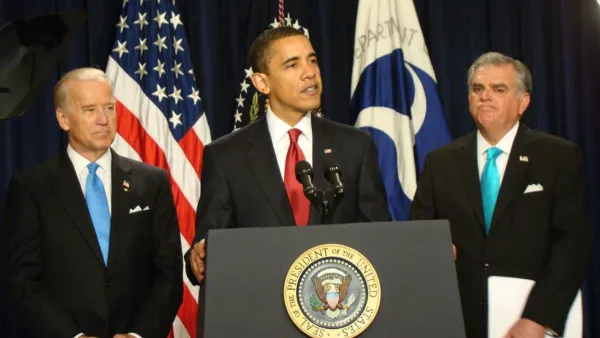
George Will, fresh from denouncing denim as 'the infantile uniform of a nation', is disturbed to find that Ray LaHood has bought the Obama administration's beliefs in regards to mass transit, bicycling, and 'transformation'.


"You might think the Department of Transportation would be a refuge from Washington's inundation of painfully earnest and pitilessly incessant talk about "remaking" this (health care, Detroit) and "transforming" that (the energy sector, the planet's temperature). Transportation, after all, is about concrete practicalities-planes, trains and automobiles, steel, asphalt and concrete.
Furthermore, the new transportation secretary, Ray LaHood, was until January a Republican congressman practicing militant middle-of-the-roadism. He knows what plays in Peoria, and not just figuratively: He is from there. Peoria is a meatloaf, macaroni-and-cheese, down-to-earth place, home of Caterpillar, the maker of earthmoving machines for building roads, runways, dams and things.
LaHood, however, has been transformed. Indeed, about three bites into lunch, the T word lands with a thump: He says he has joined a "transformational" administration: "I think we can change people's behavior.""
Read the full story: Ray Lahood, Transformed
LaHood Announces New HSR Winners & Losers
The loser list is short and no surprise: The governor-elects of OH and WI had campaigned against HSR projects in their states-they got their wish. The recipients of the redirected $1.2 billion were the surprise,with CA, FL, and WA being the happiest.
Leave Transit Projects to Transit Experts, Not Politicians
Stephen Smith sheds light on the problems of leadership holding back Obama's dream of high-speed rail.
Handicapping the Hunt for the Next Transportation Secretary
Ryan Holeywell looks at the contenders to replace Ray LaHood as Obama's Secretary of Transportation. Although his departure has not been officially announced, LaHood has previously signaled that he would leave after the president's first term.

Planetizen Federal Action Tracker
A weekly monitor of how Trump’s orders and actions are impacting planners and planning in America.

Eastern Nebraska is running out of electricity
Data centers and electrification are straining eastern Nebraska’s grid, throttling economic development.

Washington state to charge fee to drivers with fuel-efficient cars
Revenue from the fee will go towards supporting the state’s highways.

Instead of building new housing, LA developers are turning mansions into mega-mansions
In the richest areas, the number of houses valued at $30 million with demolition permits has skyrocketed since 2018.

Illinois considers spending $1 billion in taxpayer money on data center
A quantum computing campus and data center are currently under construction in Chicago.

As development costs rise, Boston moves to lessen affordable housing requirements
The Boston Zoning Commission and the City Council still need to approve Boston Mayor Michelle Wu’s proposed changes

FREE Course: Walkable City 1: Why Walkability?
After describing his path towards focusing on walkability as the essence of good planning, Jeff Speck marches through his five principal reasons for making more walkable places.
Reinventing Malls: Planning Alchemy—Turning Gray Fields Into Gold
The course focuses on the opportunities and imperatives that shape reinvention of mall sites.

City of Charlotte
City of Rosemead
Rutgers University, Edward J. Bloustein School of Planning and Public Policy
University of Michigan School for Environment and Sustainability (SEAS)
Hunter College, City University of New York (CUNY)
The Architects Foundation
University District Partnership
City of Cambridge
The Pocatello Development Authority