Preconceptions and lofty goals surround New York's soon-to-open High Line park. But the unprecedented inner city rail line conversion leaves much up in the air, according to this piece from The Architect's Newspaper.


"The fact is that there is no real precedent for the urban meandering offered by the High Line. In Italy, the evening stroll, or passagiato, is more of a mass milling funneling past outdoor cafes and fueled by coffee and Campari. America's rails to trails have streams, roller-bladers, and off-leash dogs-all verboten on the High Line. The closest match is the Promenade Plantée in Paris, although as Scofidio pointed out, it's more commonly used as a neighborhood shortcut than a destination unto itself."
"Great care has gone into heightening the new kind of experience on offer up on the High Line-the chaise lounges are positioned just where the sun always shines; the south end is wider and more hard-scaped to allow for social congregation-and Parks anticipates adding food concessions there-while the upper reaches where the surrounds are more residential narrow and soften with an actual lawn going in at 23rd Street. One of the more adventuresome features is the bleacher dropped down like a trap door-a favorite DS+R trope-right over 10th Avenue traffic. 'You'll see the city in a whole new way,' said Scofidio, 'not like mice scurrying around the edges of buildings. You never get into the space of the city like this.'"
Read the full story: 04_High Line
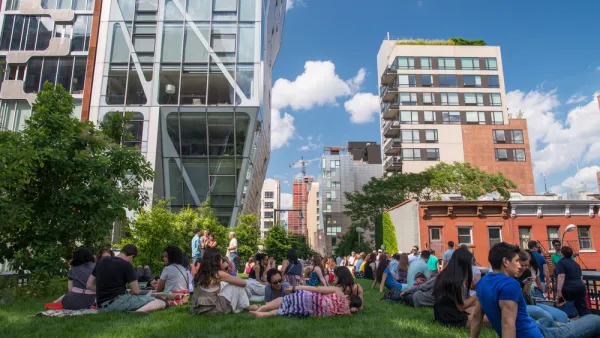
Ten Years of the High Line—Time to Reflect
As the High Line turns ten, a debate about the costs and benefits of urban revitalization continues.
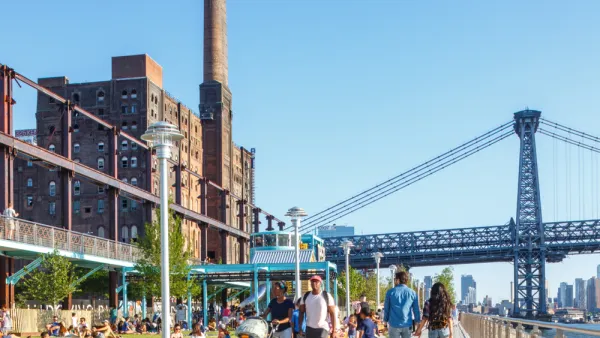
Field Operations-Designed Domino Park In Brooklyn Reviewed
The long-anticipated Domino Park, located in front of the former Domino Sugar refinery on the East River in Brooklyn, was designed by James Corner Field Operations (JFCO).
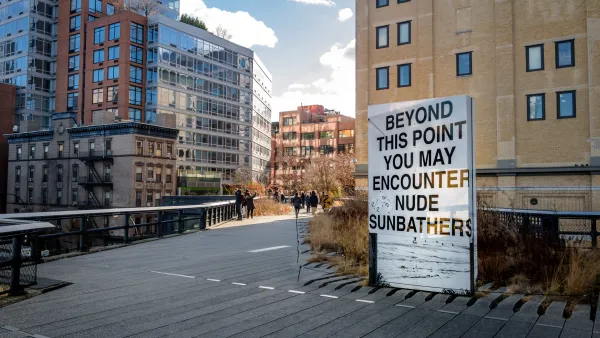
The 'Deliberately Unkind' Public Art of the High Line
"You could be forgiven for reading the art as a message to less-than-opulent New Yorkers: You’ve lost your place," writes Michael Friedman.

Planetizen Federal Action Tracker
A weekly monitor of how Trump’s orders and actions are impacting planners and planning in America.

California plans to bury El Niño’s downpour
If the state plays its cards right, it may be able to store a billion acre-feet of El Niño’s water in aquifers.

Desperate measures: Advocates weigh draining Lake Powell to fill Colorado River
Draining the reservoir could reduce evaporation losses by a couple hundred thousand acre-feet.

Los Angeles just elected an urban planner as its mayor
Transportation analysts are optimistic that Raman will be more aggressive in addressing transit issues than Bass.

Mamdani’s pied-à-terre tax survives legal challenge
A panel of judges found that the plaintiffs failed to demonstrate injury as a result of New York City's implementation of the tax.

Eastern Nebraska is running out of electricity
Data centers and electrification are straining eastern Nebraska’s grid, throttling economic development.

FREE Course: Walkable City 1: Why Walkability?
After describing his path towards focusing on walkability as the essence of good planning, Jeff Speck marches through his five principal reasons for making more walkable places.
Reinventing Malls: Planning Alchemy—Turning Gray Fields Into Gold
The course focuses on the opportunities and imperatives that shape reinvention of mall sites.

City of Rosemead
Rutgers University, Edward J. Bloustein School of Planning and Public Policy
One Hundred Miles
University of Michigan School for Environment and Sustainability (SEAS)
Hunter College, City University of New York (CUNY)
The Architects Foundation
City of Cambridge
Montrose County
The Pocatello Development Authority