Among the installations at the Ecological Urbanism exhibit at Harvard's Graduate School of Design is a collection of smells from 200 Mexico City neighborhoods.


"An artist named Sissel Tolaas gathered air samples from 200 neighborhoods in Mexico City and bottled each of these in a tiny glass bottle. She then asked 2,000 people to sniff and record their responses. Those responses, which are carefully labeled on the bottles, are as delicately discriminatory as those of a wine connoisseur.
"Rusty, sweet and old," is one. "Pleasant, aromatic, light, perfume, flowers, vanilla," is another. A huge video screen shows us the noses of people sniffing and talking - "TALKING NOSE" being Tolaas's title for the whole production. A map on the wall shows you where each of the 200 neighborhoods is located in Mexico City. There's a do-it-yourself scratch-and-sniff panel, too.
Sound silly? But there's an argument behind it. Tolaas thinks we've over-civilized ourselves to the point that we've lost touch with most of our senses. She says smell has been repressed in modern Western culture. Smells are associated with degeneracy, as in such phrases as "He smells," so we ban them from our cities and our lives. There are, Tolaas says, 10,000 perceptible smells. We've cut ourselves off from a richly sensory part of life."
Read the full story: Exhibit provides sense of the future

Report: Transit Oriented Development Leads the Market in Major Metros
A report released last week by Cushman & Wakefield has won a lot of attention from media outlets covering large-scale development market trends. Among the report's findings: growing cities need to better support transit-oriented development.

Boston sues Trump administration over revoked infrastructure grant
The Trump administration withdrew the infrastructure grant because less than 1% of the money would go to electric vehicle charging infrastructure.
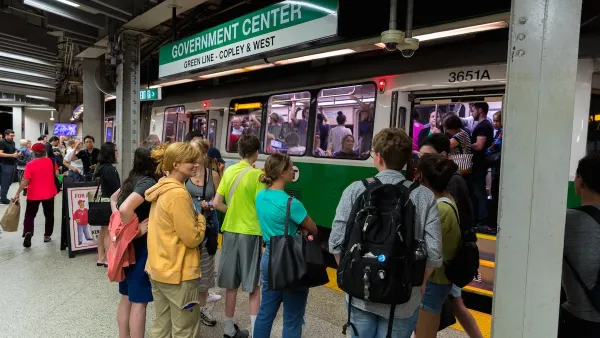
Boston has spent millions making the Green Line more accessible — and there’s no end in sight
While the city has invested millions into expanding and adding platforms to the Green Line to make it more accessible, new train cars set to arrive next year will be too tall for disabled passengers to board without raising the current platforms.

Planetizen Federal Action Tracker
A weekly monitor of how Trump’s orders and actions are impacting planners and planning in America.

‘Going backwards:’ Baltimore mayor, students rally against state's transit funding plan
Maryland's proposed six-year plan provides no funding for Baltimore’s BMORE bus program and reduces its road maintenance funding.

Record-breaking wildlife overpass in Colorado brings 91% reduction in animal collisions
Prior to the overpass, vehicles were hitting one deer per day on Colorado’s Interstate 25.

Mamdani sent nearly 6,000 pied-à-terre tax warnings to homes that didn’t qualify
A judge has ordered the administration to cancel thousands of pied-à-terre tax notices after it sent 35% of them erroneously.

Detroit to transform waterfront with $2.2 billion investment
Developers will convert about 18 acres of unused parking lot space into civic spaces.

‘Going backwards:’ Baltimore mayor, students rally against state's transit funding plan
Maryland's proposed six-year plan provides no funding for Baltimore’s BMORE bus program and reduces its road maintenance funding.

FREE Course: Walkable City 1: Why Walkability?
After describing his path towards focusing on walkability as the essence of good planning, Jeff Speck marches through his five principal reasons for making more walkable places.
Reinventing Malls: Planning Alchemy—Turning Gray Fields Into Gold
The course focuses on the opportunities and imperatives that shape reinvention of mall sites.

City of Thousand Oaks
City of Wisconsin Rapids
Harvard University Graduate School of Design
The Architects Foundation
University of Cincinnati Online
Northern Illinois Transit Authority (NITA)
The Pocatello Development Authority
The Urban Renewal Agency of the City of Pocatello