How do you turn a cul-de-sac into a commune? It's easier than you think, according to this piece from NPR.


"Architect and social designer Stephanie Smith, who runs the company Ecoshack, took me to the first official cul-de-sac commune potluck at the end of January on a newly developed bluff in Topanga Canyon, three months after she came up with the idea."
'Coming together to share resources is the basic premise of Smith's vision for the cul-de-sac commune. Hoping to learn what kinds of tools she should design to help facilitate sharing, Smith listened to Scott Vineberg, who lives in the commune, and his progressive-thinking neighbors as they brainstormed ways to go off the grid together, raise chickens and manage their stress levels."
"The stay-at-home convenience of the cul-de-sac commune is, as Smith sees it, a solution to the biggest design flaw of its predecessors."
"'In the past, utopian communities have often failed because people who started them have really insisted that the best way is to leave your old community, leave society, leave culture and start over, and it's a valid idea in many cases, but, it also leads to failure,' she said. 'So what we're interested in doing is make them effective as part of a culture, not a counterculture this time.'"
Read the full story: A Social Experiment: Communes In Cul-De-Sacs
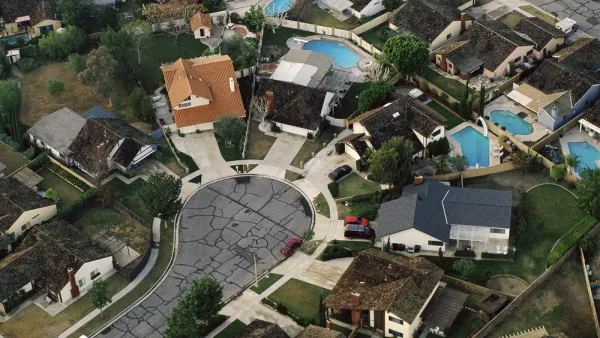
A 'Cul-De-Tax' for the Cul-De-Sac?
A recent study studying the contemporary planning profession's rejection of the cul-de-sac includes a proposal to create more economic disincentives for inefficient street grid patterns.
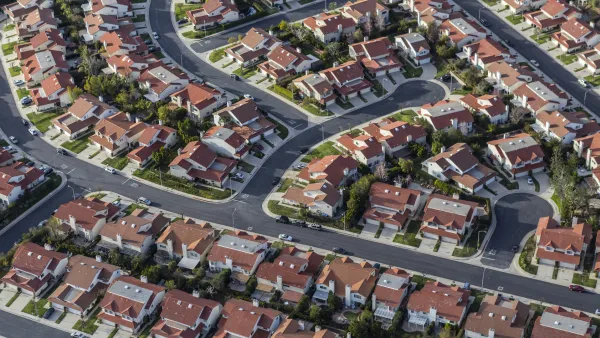
Uniform By Design: The Similarities of Suburbs
A Vox video digs into the history of how suburbs came to resemble each other.
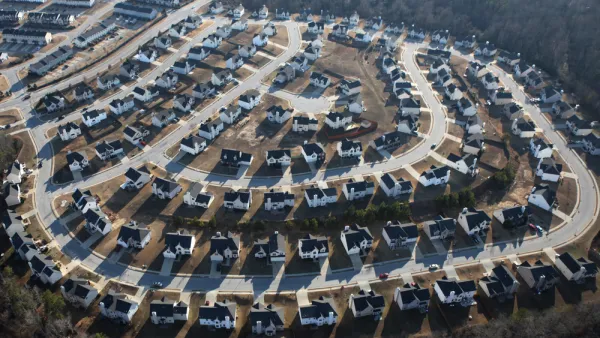
Revisiting Subdivision Regulations
For many decades now, most communities in the United States have grown as a series of subdivisions, built on a tried and true formula. It might be time to change the math.

Washington state to charge fee to drivers with fuel-efficient cars
Revenue from the fee will go towards supporting the state’s highways.

Illinois considers spending $1 billion in taxpayer money on data center
A quantum computing campus and data center are currently under construction in Chicago.

Trump to blast ‘hydrocarbon highway’ through ‘world’s longest art gallery’
Environmental and historic preservation groups are suing to stop the project.

NYC, state sue feds over mixed-immigration-status housing assistance rule
The state’s lawsuit argues that the rule change violates the Administrative Procedure Act.

Michigan to turn neighborhood into virtual power plant
Residents will soon be able to divert their excess energy to the grid in exchange for compensation.

Data center, mining project swarm to long-awaited Alaska railroad line
The state-owned railroad approved final plans for the spur line this week; the project is expected to cost $311 million, mostly funded by the federal government

FREE Course: Walkable City 1: Why Walkability?
After describing his path towards focusing on walkability as the essence of good planning, Jeff Speck marches through his five principal reasons for making more walkable places.
Reinventing Malls: Planning Alchemy—Turning Gray Fields Into Gold
The course focuses on the opportunities and imperatives that shape reinvention of mall sites.

City of Charlotte
City of Rosemead
Rutgers University, Edward J. Bloustein School of Planning and Public Policy
University of Michigan School for Environment and Sustainability (SEAS)
Hunter College, City University of New York (CUNY)
The Architects Foundation
University District Partnership