Renters are the hidden victims of the foreclosure crisis: they are usually the last to know about foreclosure, have few resources to assist them and are being overlooked by federal interventions. But community organizers are fighting back.


"The United States is in the midst of a national foreclosure crisis that threatens to wreak havoc not just on homeowners, but also tenants, urban neighborhoods, and entire cities. Community organizers and legal activists are working hard to stop it.
Foreclosures aren't just pushing owners into the street. According to the National Low Income Housing Coalition, renters make up an estimated 40% of families facing eviction because of foreclosure. And because the shakiest loans are concentrated in inner cities, the impact of vacant buildings on already fragile neighborhoods can be devastating.
Lenders and lawmakers have been slow to respond to this growing crisis. The Obama administration's mortgage rescue plan announced in February offers limited help to some individual homeowners at risk of foreclosure, but almost completely overlooks the plight of renters in foreclosed buildings. Families facing eviction are left to fend for themselves, often with little understanding of their legal rights or other options. But an array of community organizers and legal advocates have been pushing back-organizing tenants, pressuring policymakers and lenders, and throwing wrenches into the legal system."
Read the full story: Renters In the Crosshairs

Breaking News: HUD to Suspend Foreclosures and Evictions
The federal government has announced a critical effort to stabilize the economy as the country addresses the coronavirus pandemic.
In the Wake of Foreclosures, Nationwide Rents Hit All-Time High
Struggling families and young professionals are competing for a dwindling supply of ever more pricey rentals, Alejandro Lazo reports.
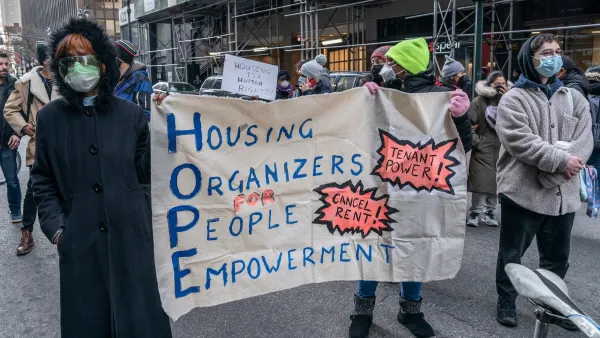
NYC 'Rental Ripoff' report calls for crackdown on negligent landlords
The report outlines strategies for empowering renters and transferring properties from 'low-road' landlords to those who focus on improved tenant outcomes.

Planetizen Federal Action Tracker
A weekly monitor of how Trump’s orders and actions are impacting planners and planning in America.

California plans to bury El Niño’s downpour
If the state plays its cards right, it may be able to store a billion acre-feet of El Niño’s water in aquifers.

Desperate measures: Advocates weigh draining Lake Powell to fill Colorado River
Draining the reservoir could reduce evaporation losses by a couple hundred thousand acre-feet.

In Texas, data centers are swallowing promised parkland
Residents who moved to Taylor, Texas for a rural community now have to contend with three data centers in their backyard.

How a Chicago-sized wind farm beat the odds and powered on
The project spanned five presidential administrations and a standoff with a U.S. military base.

MTA gives itself 30 days to transform pit into basketball court
The site has been under construction since 2022; the city originally estimated it would finish the court in 2024.

FREE Course: Walkable City 1: Why Walkability?
After describing his path towards focusing on walkability as the essence of good planning, Jeff Speck marches through his five principal reasons for making more walkable places.
Reinventing Malls: Planning Alchemy—Turning Gray Fields Into Gold
The course focuses on the opportunities and imperatives that shape reinvention of mall sites.

City of Rosemead
Rutgers University, Edward J. Bloustein School of Planning and Public Policy
One Hundred Miles
Hunter College, City University of New York (CUNY)
The Architects Foundation
University of Cincinnati Online
City of Cambridge
Montrose County
The Pocatello Development Authority