Transit officials in Eugene, Oregon, have announced plans to install a test route for a magnet-guided bus technology.


"Funded by the Federal Transit Administration, the test will measure the performance of a high-speed EmX bus that uses sensors and computer equipment to follow magnetic markers along the Franklin Boulevard route between Eugene and Springfield."
"The route could be prepared as early as this summer and the test will be done in 2010, Vobora said."
"Buses using the magnetic guidance system consistently stop within two inches or less of their mark, according to the University of California at Berkeley, which oversees the technology."
"Sensing and processing units on the bus obtain information from the magnetic markers in the road, which act as reference points."
Read the full story: LTD drawn to testing magnet control of buses
Planned Transit Service Cuts Already Causing Problems for Businesses in Pennsylvania
With big cuts coming to Capital Area Transit bus service in Cumberland County, Pennsylvania, businesses are looking for new ways to get workers to their jobs.
The Denver Bus Driver Shortage
Low wages and a strong economy are making it hard to find new bus drivers in Denver. The lack of drivers leads to decreased service.
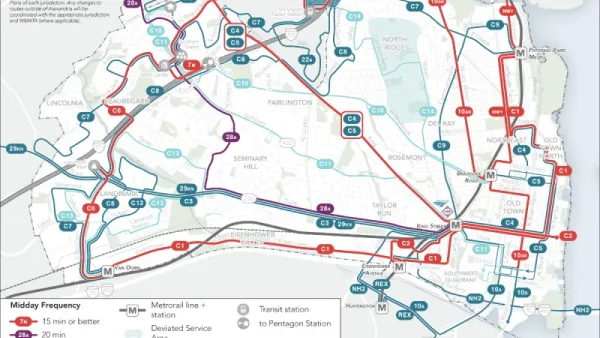
Ridership Down for Northern Virginia Public Transit
Metrorail has seen ridership improve in Northern Virginia, but not enough to balance out the losses to bus ridership.

Desperate measures: Advocates weigh draining Lake Powell to fill Colorado River
Draining the reservoir could reduce evaporation losses by a couple hundred thousand acre-feet.

Eastern Nebraska is running out of electricity
Data centers and electrification are straining eastern Nebraska’s grid, throttling economic development.

Malls are becoming the midtowns of the future
Mall and office park redevelopments are a generational opportunity to create new nodes of urbanity.

NYC breaks ground on anti-flooding infrastructure project
New York City's new system will reduce stormwater flows to local sewers by 90%.

One Kentucky town’s secret to affordable housing
The Smoketown Community Land Trust has already built seven affordable homes for community members.

Houston gains petal-shaped cooling infrastructure to make streets more ‘delightful’
The city has installed the pavilions along 15 blocks in Houston.

FREE Course: Walkable City 1: Why Walkability?
After describing his path towards focusing on walkability as the essence of good planning, Jeff Speck marches through his five principal reasons for making more walkable places.
Reinventing Malls: Planning Alchemy—Turning Gray Fields Into Gold
The course focuses on the opportunities and imperatives that shape reinvention of mall sites.

City of Rosemead
Rutgers University, Edward J. Bloustein School of Planning and Public Policy
One Hundred Miles
University of Michigan School for Environment and Sustainability (SEAS)
Hunter College, City University of New York (CUNY)
The Architects Foundation
City of Cambridge
Montrose County
The Pocatello Development Authority