Want to get kids off the street? Build playgrounds on top of skyscrapers, like in this retro-future design from 1957's Mechanix Illustrated.


"THE scene is your city on a sticky, sweltering twilight in midsummer. Lights are beginning to wink on and kids are starting to gather in the streets after the evening meal.
A few years ago this was the danger hour in your city. You remember it well-the nightly muggings would begin about now and young girls would be afraid to venture out alone. Beatings were commonplace and gang wars, fiercely fought with knives and zip-guns, were a frequent occurrence. But things are different now.
Look at the kids emerging from their homes. Instead of congregating at the candy store and pool parlor hatching * up new forms of violence out of boredom, they are now heading for the center of the block. They funnel into a large entrance and are swallowed up inside.
Follow them. They tile into elevators and are whisked upstairs. The doors open and they step into a fantasy land.
There, a few yards from the tenements where they live, on their very roofs, in fact, is a regulation-size baseball diamond with real springy turf! But the kids aren't interested just now-they played ball all afternoon. Instead, they enter the locker room and in a few minutes are cavorting noisily in a big, broad and very cool swimming pool. Afterwards, they troop onto the ball field, where chairs have been set up, and watch a movie under the stars.
What's it all about? 'This magic land for kids doesn't exist in my city,' you say. No, it doesn't-yet!"
Read the full story: Playgrounds in the Sky
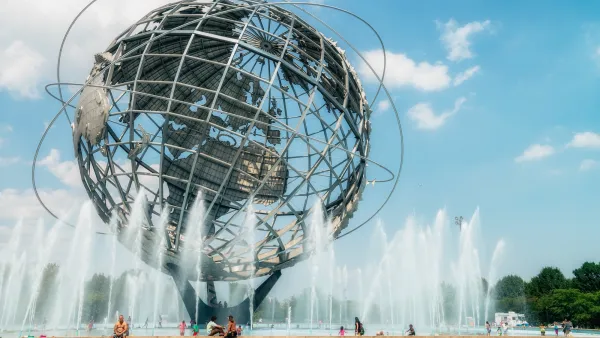
Historic Queens park is getting a $120M upgrade
The borough's largest park will undergo significant upgrades for accessibility, flood mitigation and historic preservation.
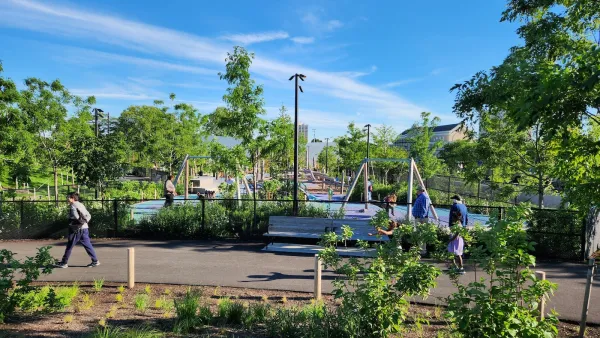
Obama Center opens nation's first presidential playground
The 21,000-square-foot play space is the first of its kind to be attached to a presidential library.
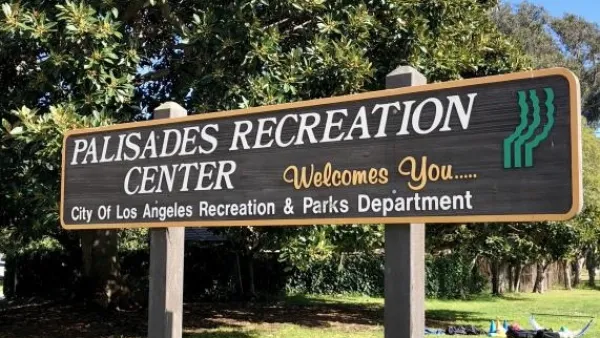
Private Donations Propel Early Restoration of Palisades Playground
Los Angeles has secured over $1.3 million in private funding to restore the Pacific Palisades playground months ahead of schedule, creating a modern, accessible space that supports community healing after recent wildfires.

Planetizen Federal Action Tracker
A weekly monitor of how Trump’s orders and actions are impacting planners and planning in America.

California plans to bury El Niño’s downpour
If the state plays its cards right, it may be able to store a billion acre-feet of El Niño’s water in aquifers.

Desperate measures: Advocates weigh draining Lake Powell to fill Colorado River
Draining the reservoir could reduce evaporation losses by a couple hundred thousand acre-feet.

Mamdani’s pied-à-terre tax survives legal challenge
A panel of judges found that the plaintiffs failed to demonstrate injury as a result of New York City's implementation of the tax.

Eastern Nebraska is running out of electricity
Data centers and electrification are straining eastern Nebraska’s grid, throttling economic development.

Seattle passes record-breaking transit services expansion
Proposition 1 will double the city’s transit tax to add 95,000 more bus trips and preserve 180,000 bus trips annually.

FREE Course: Walkable City 1: Why Walkability?
After describing his path towards focusing on walkability as the essence of good planning, Jeff Speck marches through his five principal reasons for making more walkable places.
Reinventing Malls: Planning Alchemy—Turning Gray Fields Into Gold
The course focuses on the opportunities and imperatives that shape reinvention of mall sites.

City of Rosemead
Rutgers University, Edward J. Bloustein School of Planning and Public Policy
One Hundred Miles
University of Michigan School for Environment and Sustainability (SEAS)
Hunter College, City University of New York (CUNY)
The Architects Foundation
City of Cambridge
Montrose County
The Pocatello Development Authority