Billions of North American birds are killed each year by flying into windows, studies suggest.


"As many as two billion birds die in North America every year as a result of smashing into windows, according to a recent re-analysis of window-kill avian losses. Much of the mortality goes unnoticed because many of the victims' carcasses are rapidly removed by crows, cats, raccoons, rats, gulls and other scavengers before they are seen by human passersby.
A preliminary 1990 analysis of the number of birds killed by flying into window panes, by Daniel Klem of Muhlenberg College, suggested the North American toll probably tops one billion birds. That figure was based on per-building avian deaths of up to 10 per year. But recent studies indicate actual per-building avian losses are four to six times greater than that.
Dozens of recent studies suggest the per-building avian toll is 29 to 60 per year. Although there are no concise figures for the Prairies, data from the Fatal Light Awareness Program suggests up to 10 million birds strike buildings in the Metropolitan Toronto area every year. The New York City Project Safe Flight confirms some downtown buildings kill more than 250 birds each year. One study estimates one million of the eight million birds that migrate annually across the Chicago area are killed as a result of smashing into buildings in that city."
FULL STORY: On Panes of Death


Are cities at risk of losing squirrels?
Book review: A common backyard forager could be in decline, but without the proper data we may not know until it’s too late. Nancy Castaldo’s "Squirrel" urges us to find out.
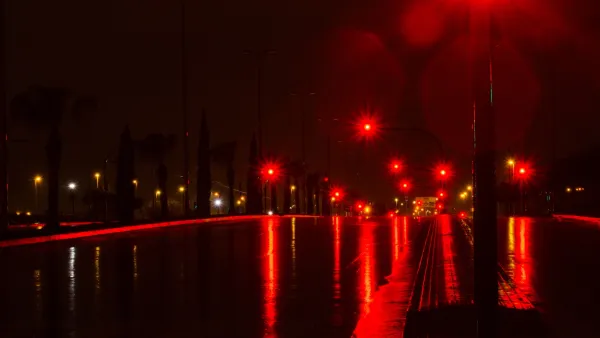
Danish Suburb Introduces Red Streetlights to Protect Nocturnal Species
The town of Gladsaxe is using red-spectrum LEDs to illuminate streets where bat species congregate.

San Diego County Sees a Rise in Urban Coyotes
San Diego County experiences a rise in urban coyotes, as sightings become prevalent throughout its urban neighbourhoods and surrounding areas.

Planetizen Federal Action Tracker
A weekly monitor of how Trump’s orders and actions are impacting planners and planning in America.

The state-sanctioned urbicide of Austin
People don’t kill cities. Freeways do.

US to reduce Colorado River water deliveries to Mexico
A new Colorado Treaty amendment reduces Mexico’s Colorado River water allocation by 250,000 acre feet.

5 New England states march closer to 800 megawatt wind energy project
Securing federal approval for the project may be complicated under the Trump administration, which has historically been hostile towards domestic wind power.

Baltimore to break ground on $50 million Transit Priority Project
The project will bring faster bus trips, safer streets and better bike connections to Baltimore.

Airbnb launches $250 million 'last-dollar financing' housing accelerator, makes first investment in Austin
The company will put $6.4 million towards affordable housing development in Texas’ capital.

FREE Course: Walkable City 1: Why Walkability?
After describing his path towards focusing on walkability as the essence of good planning, Jeff Speck marches through his five principal reasons for making more walkable places.
Reinventing Malls: Planning Alchemy—Turning Gray Fields Into Gold
The course focuses on the opportunities and imperatives that shape reinvention of mall sites.

Eagle County Government
Harvard University Graduate School of Design
Nashville Planning Department
The Architects Foundation
University of Cincinnati Online
The Pocatello Development Authority
The Urban Renewal Agency of the City of Pocatello
Journal of the American Planning Association