Fewer teardowns and new home starts back up the perception that the age of the McMansion is coming to an end.


"Indeed, it may allow thousands of communities from Pasadena to Pittsburgh to more accurately balance the living requirements of modern Americans with a widespread desire to maintain older neighborhoods."
"'We're advising communities to take advantage of this slowdown and use it as a cooling-off period,' says Adrian Fine, a regional director for the National Trust for Historic Preservation in Washington. 'It gives them a little more time to have a less heated and less controversial discussion to protect a specific neighborhood and balance that with the need for growth and development.'"
"With housing prices off by 18 percent in 20 US cities in the last year and new home starts at a 26-year low, bulldozers have slowed their march across American cities and towns."
"In Westport, Conn., teardown permits are down in the last year by 33 percent – a figure that experts say can be extrapolated nationwide, though teardown trends do have significant regional variations. Analysts expect the lull to last at least five years, perhaps 10."
Read the full story: The 'McMansion' trend in housing is slowing
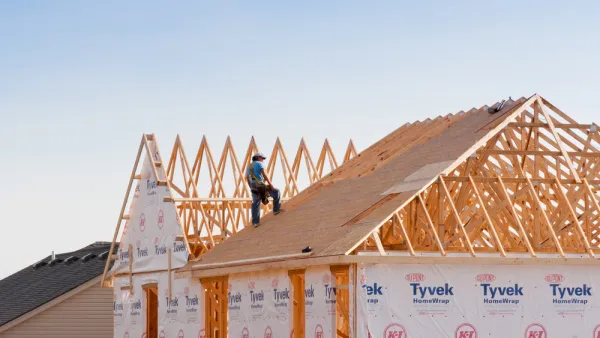
Housing Construction More and More Frequently the Product of Two Companies
The history of U.S. housing construction has traditionally been the story of many companies building a few homes a year. Now two companies alone are out-building the rest of the top ten homebuilders combined.
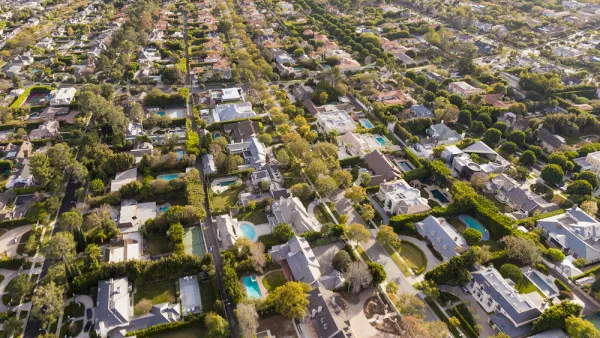
L.A.'s Crackdown on McMansions Hasn't Stopped Them from Going Up
Legislation to stop construction of McMansions is being undermined by a zoning loophole.
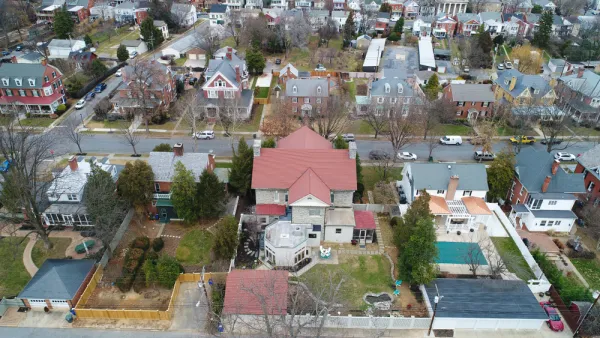
McMimpact Fee Proposed
Should there be an extra fee for property owners who tear down an existing single-family home and replace it with a much larger, more expensive single-family home?

Planetizen Federal Action Tracker
A weekly monitor of how Trump’s orders and actions are impacting planners and planning in America.

Eastern Nebraska is running out of electricity
Data centers and electrification are straining eastern Nebraska’s grid, throttling economic development.

Study reveals best places in the U.S. for cycling, walking
New research from Streetlight Data examines bicycle and pedestrian miles per capita in the 100 largest U.S. cities by population.

DSA members accuse Mamdani of 'abandoning values' over housing redevelopment
New York City's mayor plans to replace about 2,000 units of public housing with private, mixed-income housing.

All sides of BRT debate unhappy with CDOT’s most recent move
The Colorado Department of Transportation is no longer considering center-running bus lanes for Colorado Boulevard.

Massachusetts bogs generate both power, and cranberries
Putting solar panels above farmland is one way Massachusetts is advancing toward its goal of net-zero carbon emissions by 2050.

FREE Course: Walkable City 1: Why Walkability?
After describing his path towards focusing on walkability as the essence of good planning, Jeff Speck marches through his five principal reasons for making more walkable places.
Reinventing Malls: Planning Alchemy—Turning Gray Fields Into Gold
The course focuses on the opportunities and imperatives that shape reinvention of mall sites.

City of Rosemead
Rutgers University, Edward J. Bloustein School of Planning and Public Policy
One Hundred Miles
University of Michigan School for Environment and Sustainability (SEAS)
Hunter College, City University of New York (CUNY)
The Architects Foundation
City of Cambridge
The Pocatello Development Authority
The Urban Renewal Agency of the City of Pocatello