Degradation of soils has brought down many human civilizations. Our current industrial agriculture practices threaten the future of human existence. A 50-year farm bill is needed to guide policy on a more sustainable path, according to this oped.


"Unlike oil, it has no technological substitute - and no powerful friends in the halls of government."
"Agriculture has too often involved an insupportable abuse and waste of soil, ever since the first farmers took away the soil-saving cover and roots of perennial plants. Civilizations have destroyed themselves by destroying their farmland. This irremediable loss, never enough noticed, has been made worse by the huge monocultures and continuous soil-exposure of the agriculture we now practice."
"Industrial agricultural has made our food supply entirely dependent on fossil fuels and, by substituting technological "solutions" for human work and care, has virtually destroyed the cultures of husbandry (imperfect as they may have been) once indigenous to family farms and farming neighborhoods."
"Clearly, our present ways of agriculture are not sustainable, and so our food supply is not sustainable. We must restore ecological health to our agricultural landscapes, as well as economic and cultural stability to our rural communities."
Read the full story: A 50-Year Farm Bill
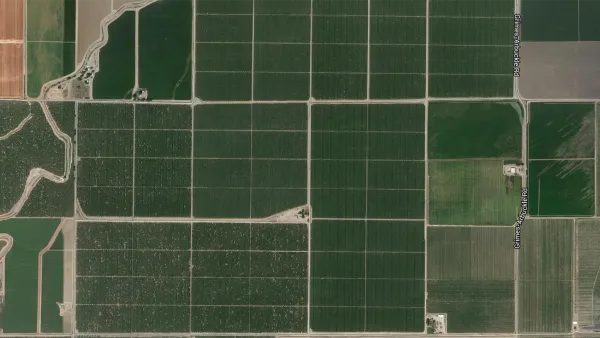
Study: Agriculture's Carbon Output Higher Than Previously Thought
Over the span of history, agricultural uses have released nearly as much carbon into the atmosphere as actual deforestation. New problem areas are still appearing in places like Brazil.
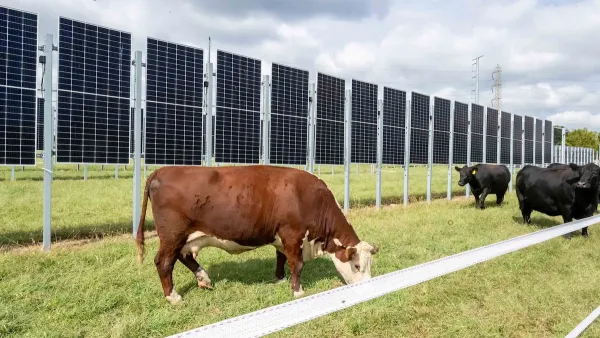
New Jersey Agrivoltaic Project Combines Solar Energy With Farming
A Rutgers University-New Brunswick demonstration farm will evaluate solar array designs to understand how they can best support grazing and agriculture on the same site.
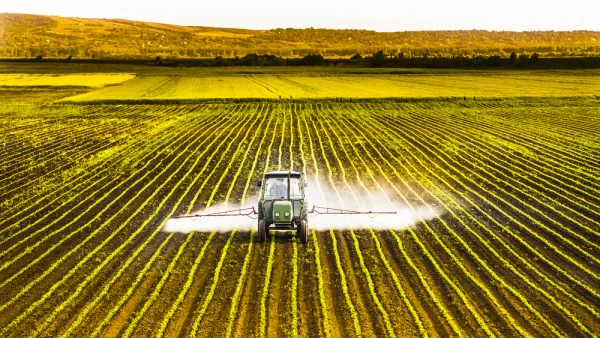
Land Use the Subject of Latest IPCC Report
Not urban land use, but in the literal sense: land used to produce food, graze livestock, supply drinking water, grow trees, and sequester carbon. As the climate warms and the population grows, crop yields will decrease and land will be degraded.

Planetizen Federal Action Tracker
A weekly monitor of how Trump’s orders and actions are impacting planners and planning in America.

California plans to bury El Niño’s downpour
If the state plays its cards right, it may be able to store a billion acre-feet of El Niño’s water in aquifers.

Desperate measures: Advocates weigh draining Lake Powell to fill Colorado River
Draining the reservoir could reduce evaporation losses by a couple hundred thousand acre-feet.

Housing is the top priority of Seattle’s sole new councilmember
Jenks campaigned on building 1,000 new units of affordable housing.

New tax cuts may slash $1.5 billion in funding for Miami transit, public parks
Amendment 3 will save Miami-Dade homeowners $2,700 in 2028.

Arizona, Wisconsin, Pennsylvania hope to finally advance climate goals post-midterms
The three states have spent years under Republican or divided control.

FREE Course: Walkable City 1: Why Walkability?
After describing his path towards focusing on walkability as the essence of good planning, Jeff Speck marches through his five principal reasons for making more walkable places.
Reinventing Malls: Planning Alchemy—Turning Gray Fields Into Gold
The course focuses on the opportunities and imperatives that shape reinvention of mall sites.

City of Rosemead
Rutgers University, Edward J. Bloustein School of Planning and Public Policy
One Hundred Miles
University of Michigan School for Environment and Sustainability (SEAS)
Hunter College, City University of New York (CUNY)
The Architects Foundation
City of Cambridge
Montrose County
The Pocatello Development Authority