A court order prohibits new bicycle infrastructure in San Francisco, but its Municipal Transportation Agency and Planning Department have crafted a 1,353-page Draft Environmental Impact Report to make a case against it.


"At a cost of more than $1 million, the city has attempted to demonstrate in excruciating detail what would seem to be obvious: better bicycle amenities contribute to increased cycling and an improved environment.
Despite the significant time and money required to produce the tome, Mayor Gavin Newsom struck an optimistic note, citing the proposed addition of 34 miles of bicycle lanes to San Francisco streets - a 75 percent increase over the existing 45 miles of lanes.
'We've accomplished a great deal together, but much work remains to be done to improve the safety and convenience of bicycling,' said Newsom. 'I will continue to push for a better bicycling environment as part of my deep commitment to improving the health of our environment, our residents and our city.'
A public hearing on the DEIR has been scheduled for January 8. The deadline for comments is January 13."
Thanks to Matthew Roth
Read the full story: SF Responds to Bike Injunction With 1,353 Page Enviro Review
Best Ideas of the Week
Another week has passed, and some more exciting and interesting ideas have taken root in the world of urban planning.
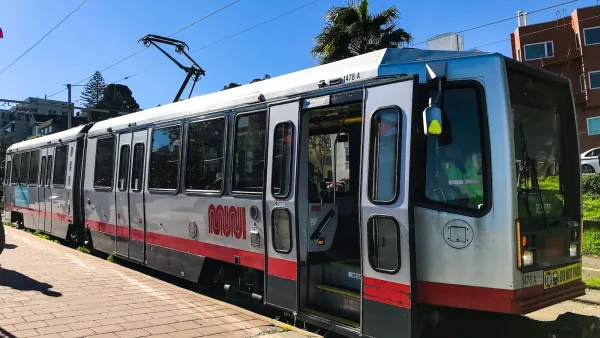
San Francisco cyclists push to allow bikes on Muni trains
The agency is one of few that bans bikes from its trains due to space constraints.

Creating Ocean-Safe Plastic from Seashells
USC researchers have created a biodegradable, marine-safe plastic alternative using calcium carbonate from seashells, offering a promising solution to ocean pollution.

Planetizen Federal Action Tracker
A weekly monitor of how Trump’s orders and actions are impacting planners and planning in America.

California plans to bury El Niño’s downpour
If the state plays its cards right, it may be able to store a billion acre-feet of El Niño’s water in aquifers.

Desperate measures: Advocates weigh draining Lake Powell to fill Colorado River
Draining the reservoir could reduce evaporation losses by a couple hundred thousand acre-feet.

Mamdani’s pied-à-terre tax survives legal challenge
A panel of judges found that the plaintiffs failed to demonstrate injury as a result of New York City's implementation of the tax.

Eastern Nebraska is running out of electricity
Data centers and electrification are straining eastern Nebraska’s grid, throttling economic development.

Seattle passes record-breaking transit services expansion
Proposition 1 will double the city’s transit tax to add 95,000 more bus trips and preserve 180,000 bus trips annually.

FREE Course: Walkable City 1: Why Walkability?
After describing his path towards focusing on walkability as the essence of good planning, Jeff Speck marches through his five principal reasons for making more walkable places.
Reinventing Malls: Planning Alchemy—Turning Gray Fields Into Gold
The course focuses on the opportunities and imperatives that shape reinvention of mall sites.

City of Rosemead
Rutgers University, Edward J. Bloustein School of Planning and Public Policy
One Hundred Miles
University of Michigan School for Environment and Sustainability (SEAS)
Hunter College, City University of New York (CUNY)
The Architects Foundation
City of Cambridge
Montrose County
The Pocatello Development Authority