With thousands more licensed taxis than New York City, Dublin Ireland is facing a glut of idle cabs.


"The most visible sign of the Irish recession is not the endless 'For Sale' or 'Price Reduced' signs that line residential and business streets; it is the sheer number of idle taxis. At some taxi stands in central Dublin, the cars are lined up a two dozen deep, their drivers bored rigid behind the wheel.
No wonder: There are about 16,000 licensed taxis in Dublin, up from about 2,800 in the late 1990s. That's a lot of taxis. New York City, which is 7 or 8 times bigger than Dublin (population 1.2-million), has about 13,000 licensed cabs.
A decade ago, Dubliners complained about having to wait an hour or longer for a cab. So the city deregulated the licensing process. Almost anyone could get in the taxi game and the numbers grew enormously. [Then] the recession...hit and drivers are getting desperate. Dublin could do with half the number of taxis."
Read the full story: The biggest taxi glut in Europe

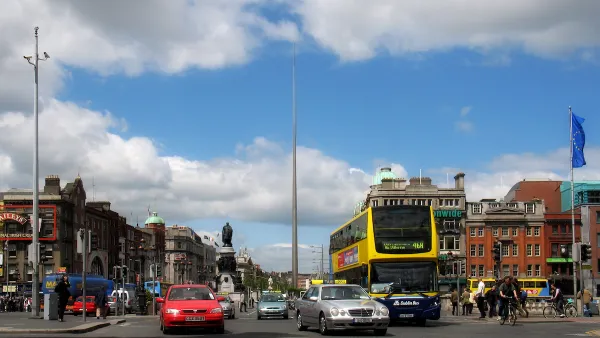
Dublin Will Ban Through Traffic Downtown
A vast majority of residents support a plan to limit vehicular traffic through the city’s center.
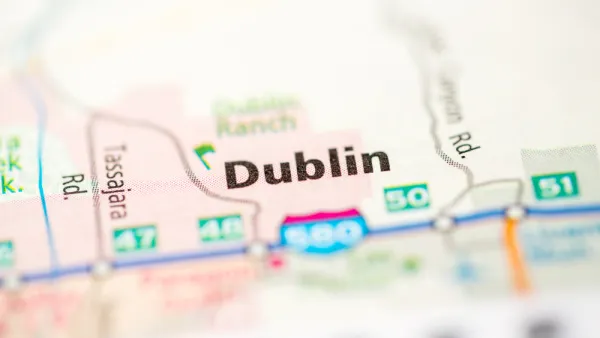
Growing Anti-Development Sentiment Kills Mixed-Use Proposal in East Bay City
The city of Dublin, located adjacent to the I-580/I-680 intersection in the East Bay Area, pulled the plug on a proposed mixed-use development that would have added apartments, senior houses, restaurants, and a theater to the quickly growing city.
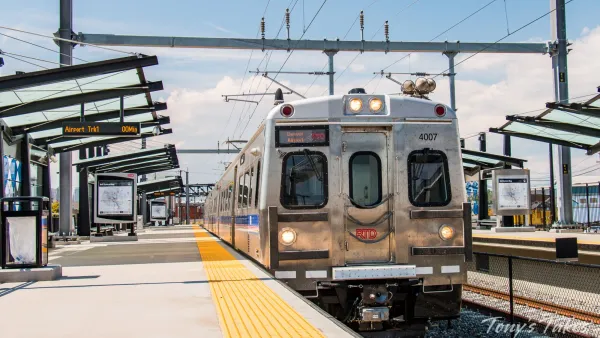
Fewer People Parking at Denver Airport, While Ride Hailing and Rail Numbers Are on the Rise
More people are using the A-Line, Uber, and Lyft to travel to and from Denver International Airport (DIA). With parking numbers down, DIA has scrapped plans for two new parking garages.

Planetizen Federal Action Tracker
A weekly monitor of how Trump’s orders and actions are impacting planners and planning in America.

Amtrak, CN end decades-long dispute with eight-year agreement
The new operating agreement establishes an updated framework for the companies to work together, including processes to resolve disputes.

Judges permit Denver to divert 77,000 acre feet from the Colorado River for reservoir expansion
Overuse and climate change have caused the Colorado River’s water levels to plummet.

NYC DOT wants faster, more permanent street upgrades
The city is examining ways to build more concrete infrastructure without getting entangled in 'decades-long' projects.

'Something we’ve never seen before:' rising utility rates could strain city finances nationwide
Data centers, climate change and other factors have caused utility rates in the United States to increase by 38% since 2020.

Trump to overrule local leaders, lease millions of acres of America’s Pacific Island territories’ seafloors to mining companies
International law says that the Indigenous people of America’s territories have a right to prior and informed consent regarding projects that impact their countries.

FREE Course: Walkable City 1: Why Walkability?
After describing his path towards focusing on walkability as the essence of good planning, Jeff Speck marches through his five principal reasons for making more walkable places.
Reinventing Malls: Planning Alchemy—Turning Gray Fields Into Gold
The course focuses on the opportunities and imperatives that shape reinvention of mall sites.

Harvard University Graduate School of Design
KFH Group Inc.
Greater Baltimore Committee
The Architects Foundation
University of Cincinnati Online
The Pocatello Development Authority
The Urban Renewal Agency of the City of Pocatello