After noise complaints by residents nearby, any exercise that takes place on a grassy traffic median in Santa Monica that can qualify as "congregating" has been banned.


"The target is increasingly loud, littering and generally intrusive groups of exercisers who gather from dawn until dusk along the Fourth Street median. The ocean view, the air and for some the architectural spectacle have transformed the area into a huge outdoor gym rimmed by multimillion-dollar homes.
In the last six months, park rangers, dispatched by the Santa Monica Police Department in response to complaining neighbors, have stationed themselves on the corner of Fourth Street and Adelaide Drive during much of the day, at the ready to break up any unauthorized kickboxing."
"Naturally, a fair share of exercisers are unhappy with the new enforcement, and at a recent City Council meeting, officials batted the matter around: Would the law withstand legal challenges? What constitutes too 'early' to be awoken by whistles? But there was no resolution."
Read the full story: Police stakeouts replace workouts in California city


CA city to shut down airport, transform it into utopian park
The western side of the 200-acre park will feature a dog park, nature education center and arboretum.

Judge orders Waymo to stop using 2 Santa Monica charging stations after noise complaints
Neighbors have asked the city to ban the company from using charging stations in residential areas between 11pm and 6am.
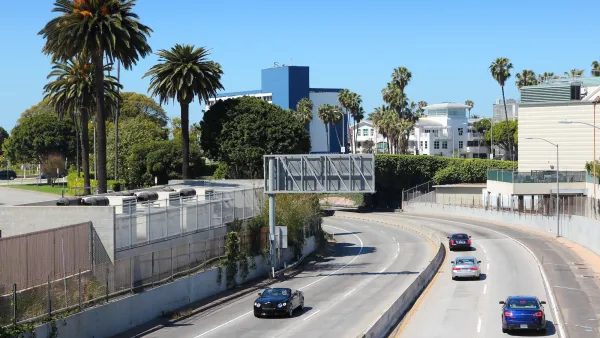
Santa Monica gets $2M grant to study I-10 freeway cap
City officials want to explore capping or even removing a portion of the freeway in the Pico neighborhood.

Planetizen Federal Action Tracker
A weekly monitor of how Trump’s orders and actions are impacting planners and planning in America.

Chicago breaks ground on $3 billion megadevelopment
The new neighborhood, titled Foundry Park, will one day host 3,700 residences.

This MA town is drowning in its own sewage — and residents like it that way
Susan Murcott, a waste water expert, said if Carlisle didn't address their leaking sewage, the problem could turn “deadly.”

Feds to more closely scrutinize proposed Amtrak facility’s environmental impact
The Federal Railroad Administration had initially said the facility qualified for a less extensive environmental review.

Boston is hard to build housing in: its chief of planning wants to keep it that way
Chief of Planning Kairos Shen said she would not make changes to Boston’s affordability requirements for new housing, which critics say have slowed down development.

California plans to bury El Niño’s downpour
If the state plays its cards right, it may be able to store a billion acre-feet of El Niño’s water in aquifers.

FREE Course: Walkable City 1: Why Walkability?
After describing his path towards focusing on walkability as the essence of good planning, Jeff Speck marches through his five principal reasons for making more walkable places.
Reinventing Malls: Planning Alchemy—Turning Gray Fields Into Gold
The course focuses on the opportunities and imperatives that shape reinvention of mall sites.

City of Rosemead
Rutgers University, Edward J. Bloustein School of Planning and Public Policy
One Hundred Miles
Hunter College, City University of New York (CUNY)
The Architects Foundation
University of Cincinnati Online
Montrose County
The Pocatello Development Authority
The Urban Renewal Agency of the City of Pocatello