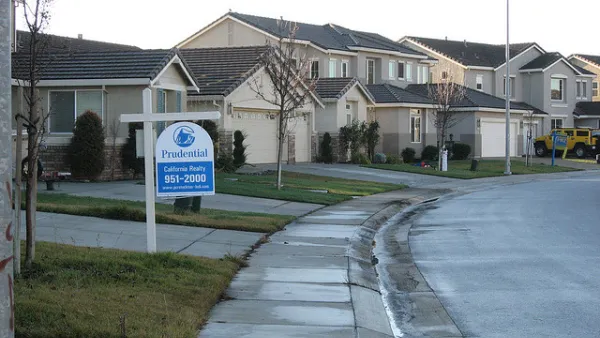
Almost 90% of the homeowners in Mountain House, CA, a planned smart growth community in the Central Valley, owe more on their mortgages than their homes are worth- the highest percentage in the country.


"The average homeowner in Mountain House is 'underwater,' as it is known, by $122,000.
A visit to the area over the last couple of days shows how the nationwide housing crisis is contributing to a broad slowdown of the American economy, as families who feel burdened by high mortgages are pulling back on their spending.
Jerry Martinez, a general contractor, and his wife, Marcie, an accounts clerk, are among the struggling owners in Mountain House. Burdened with credit card debt and a house losing value by the day, they are learning the necessity of self-denial for themselves and their three children.
No more family bowling night. No more dinners at Chili's or Applebee's. No more going to the movies.
'We make decent money, but it takes a tremendous amount to pay the mortgage,' Mr. Martinez, 33, said."
Read the full story: A Town Drowns in Debt as Home Values Plunge
Subprime Loans Are Back—Now They're Called Nonprime Loans
Some say that "nonprime" loans will create the same financial ruins as their "subprime" predecessors. Others say the housing market needs ways for more people to buy homes and drive the industry.
The Last Days of the Home Affordable Modification Program
The Washington Post takes stock of the Home Affordable Modification Program (HAMP) in its final days, finding a program hampered by bad faith from large banks and bad oversight by the Treasury Department.
The Case for Making Federal Housing Programs Like HAMP and HARP Permanent
There have been a number of federal and state programs to address the housing and foreclosure crisis. While these programs have helped a lot of people and continue to do so, many people that are qualified still have trouble completing these programs.

Planetizen Federal Action Tracker
A weekly monitor of how Trump’s orders and actions are impacting planners and planning in America.

California plans to bury El Niño’s downpour
If the state plays its cards right, it may be able to store a billion acre-feet of El Niño’s water in aquifers.

Desperate measures: Advocates weigh draining Lake Powell to fill Colorado River
Draining the reservoir could reduce evaporation losses by a couple hundred thousand acre-feet.

US buildings threatened, destroyed by fires set to triple by 2060
Researchers found a high fire risk for socioeconomically vulnerable neighborhoods in the American West.

LA residents may be allowed to paint their own crosswalks
Councilwoman Katy Yaroslavsky put out a motion instructing the Los Angeles Department of Public Transportation to study the feasibility of allowing volunteers to paint crosswalks.

Dallas moves to overhaul its zoning code
The city's zoning reform will allow more multi-family and mixed-use developments.

FREE Course: Walkable City 1: Why Walkability?
After describing his path towards focusing on walkability as the essence of good planning, Jeff Speck marches through his five principal reasons for making more walkable places.
Reinventing Malls: Planning Alchemy—Turning Gray Fields Into Gold
The course focuses on the opportunities and imperatives that shape reinvention of mall sites.

City of Rosemead
Rutgers University, Edward J. Bloustein School of Planning and Public Policy
One Hundred Miles
Hunter College, City University of New York (CUNY)
The Architects Foundation
University of Cincinnati Online
City of Cambridge
Montrose County
The Pocatello Development Authority