Vancouver Olympic officials have announced that temporary Olympic housing units will be reused as permanent affordable housing after the Games.


"'This will be a long-term legacy,' [Premier Gordon] Campbell told workers assembled at the VANOC headquarters in Vancouver. 'There will be an Olympic legacy for all of B.C.' The units are expected to be available for use in late 2010, with the various communities taking care of water, plumbing, sewer and foundation work before the Games begin, so the post-Olympic requirements are minimal.
The move by Campbell is also aimed to please members of B.C.'s hinterland, who have argued that while all British Columbians will pay for the 2010 Olympics, Vancouver and Whistler are getting the lion's share of its windfall."
"VANOC CEO John Furlong said the $43.6-million cost of the housing project will be shared by VANOC, corporate sponsors RONA and Britco, a large private donation that will be made public at a later date, the province of B.C., and land donated by the participating communities, which were chosen when they demonstrated a need for such facilities."
Read the full story: Olympic housing pledge to benefit communities
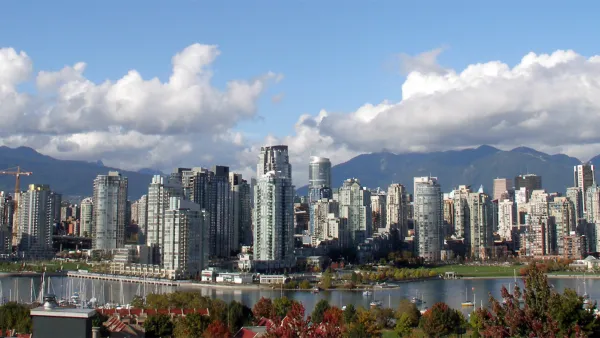
Vancouver City Council Eliminates Parking Mandates, Supports TOD
In a significant step for more diverse housing and transit-friendly development, the Vancouver City Council eliminated parking minimums and adopted a Transit-Oriented Areas (TOA) policy.
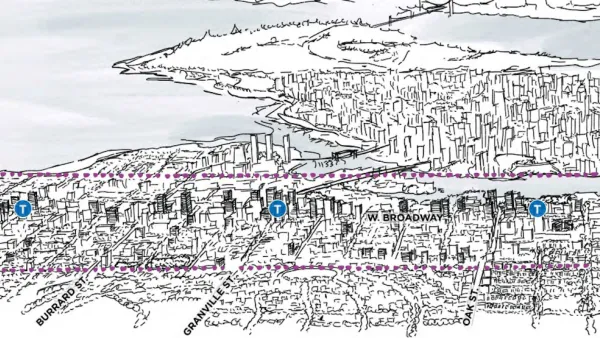
Vancouver’s Controversial Broadway Plan Approved With Amendments
A plan to add new significant amounts of housing, shifting development south into a “second downtown” around the future SkyTrain Millennium Line Broadway Extension, has been approved in Vancouver.
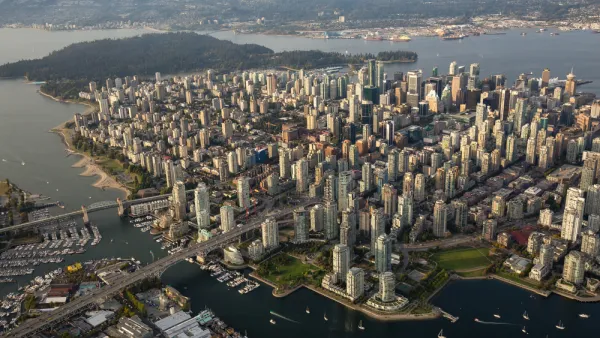
Vancouver Set To Finalize Broadway Rezoning Plan
A plan to increase density along the city's 'Second Downtown' promises to bring badly needed housing to the corridor as the Broadway subway line nears completion.

Planetizen Federal Action Tracker
A weekly monitor of how Trump’s orders and actions are impacting planners and planning in America.

California plans to bury El Niño’s downpour
If the state plays its cards right, it may be able to store a billion acre-feet of El Niño’s water in aquifers.

Desperate measures: Advocates weigh draining Lake Powell to fill Colorado River
Draining the reservoir could reduce evaporation losses by a couple hundred thousand acre-feet.

Mamdani’s pied-à-terre tax survives legal challenge
A panel of judges found that the plaintiffs failed to demonstrate injury as a result of New York City's implementation of the tax.

Eastern Nebraska is running out of electricity
Data centers and electrification are straining eastern Nebraska’s grid, throttling economic development.

Seattle passes record-breaking transit services expansion
Proposition 1 will double the city’s transit tax to add 95,000 more bus trips and preserve 180,000 bus trips annually.

FREE Course: Walkable City 1: Why Walkability?
After describing his path towards focusing on walkability as the essence of good planning, Jeff Speck marches through his five principal reasons for making more walkable places.
Reinventing Malls: Planning Alchemy—Turning Gray Fields Into Gold
The course focuses on the opportunities and imperatives that shape reinvention of mall sites.

City of Rosemead
Rutgers University, Edward J. Bloustein School of Planning and Public Policy
One Hundred Miles
University of Michigan School for Environment and Sustainability (SEAS)
Hunter College, City University of New York (CUNY)
The Architects Foundation
City of Cambridge
Montrose County
The Pocatello Development Authority