As new design requirements come in at a late stage, bridge planners in Portland are trying to nail down a design for the new light rail bridge that is affordable, appropriate and beautiful. But the beauty aspect may fall to economics.


"Intended mainly to carry a new MAX light rail line to Milwaukie and the southeast, the bridge also would carry streetcars, buses, bicyclists and pedestrians across the river -- but no cars."
"Engineering and cost considerations are throwing hurdles at the bridge, calling for it to span tall and wide enough for barges in the river, yet low enough for train stations to nestle comfortably a few blocks from the riverbank.
"'Beautiful' is a major wild card in this debate. It may be more expensive, depending on whom you talk to."
"And it underscores a key question driving the design: Must this bridge live in the context of its neighbors, the cagelike Interstate 5 Marquam Bridge to the north and humble concrete Ross Island to the south? Or should it make its own memorable statement?"
Read the full story: Willamette bridge planners say design is key

Portland gathers to pay respects to the last of its original light rail cars
The TriMet agency has fully replaced its aging fleet of Type 1 cars.
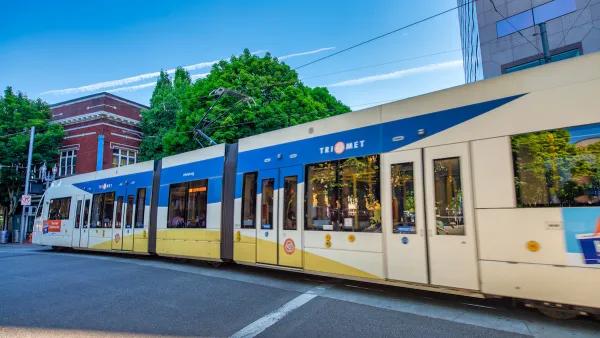
Portland Train Speed Limited by Extreme Heat
When temperatures hit 100 degrees, the city’s two train systems face challenges that force them to slow their speeds or stop operations altogether.
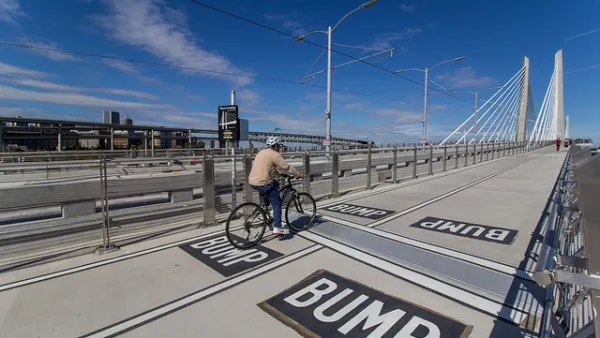
Portland and Multnomah County Push for Lower Speed Limits on Bridges
The Portland Bureau of Transportation and Multnomah County agree on a 30 mph speed limit on five downtown bridges, but the state's department of transportation denied the change on two key spans.

Planetizen Federal Action Tracker
A weekly monitor of how Trump’s orders and actions are impacting planners and planning in America.

Eastern Nebraska is running out of electricity
Data centers and electrification are straining eastern Nebraska’s grid, throttling economic development.

Washington state to charge fee to drivers with fuel-efficient cars
Revenue from the fee will go towards supporting the state’s highways.

Instead of building new housing, LA developers are turning mansions into mega-mansions
In the richest areas, the number of houses valued at $30 million with demolition permits has skyrocketed since 2018.

Illinois considers spending $1 billion in taxpayer money on data center
A quantum computing campus and data center are currently under construction in Chicago.

As development costs rise, Boston moves to lessen affordable housing requirements
The Boston Zoning Commission and the City Council still need to approve Boston Mayor Michelle Wu’s proposed changes

FREE Course: Walkable City 1: Why Walkability?
After describing his path towards focusing on walkability as the essence of good planning, Jeff Speck marches through his five principal reasons for making more walkable places.
Reinventing Malls: Planning Alchemy—Turning Gray Fields Into Gold
The course focuses on the opportunities and imperatives that shape reinvention of mall sites.

City of Charlotte
City of Rosemead
Rutgers University, Edward J. Bloustein School of Planning and Public Policy
University of Michigan School for Environment and Sustainability (SEAS)
Hunter College, City University of New York (CUNY)
The Architects Foundation
University District Partnership
City of Cambridge
The Pocatello Development Authority