Going beyond traditional approaches to public art, Washington's transit authority has launched a program that provides the city with art that expresses Seattle's "core identity."


"[Public] art tends to be intimate, part of the fabric of daily life. Design team art connects people with the particular place in which they live. To this day, the best way to get a sense of what artists have brought to the city is to walk through the neighborhoods with a sharp eye. There's art in the sidewalks, on light fixtures, in bus shelters and park benches, playgrounds, libraries, police and fire stations, everywhere you might encounter it by surprise.
This approach has limitations. It tends to lack the wow factor. And if administrators of public art programs chose artists who are better at selling a committee than delivering the product, art tends to recede into civic decoration. It isn't going to upset anybody, but it won't change lives, either.
Enter Sound Transit's STart program, administered by Barbara Luecke. There are design team artists involved in creation of the rails, stations and miniparks, but there are also artists anchoring central stops with major works of art."
Read the full story: Art lights the way for Sound Transit

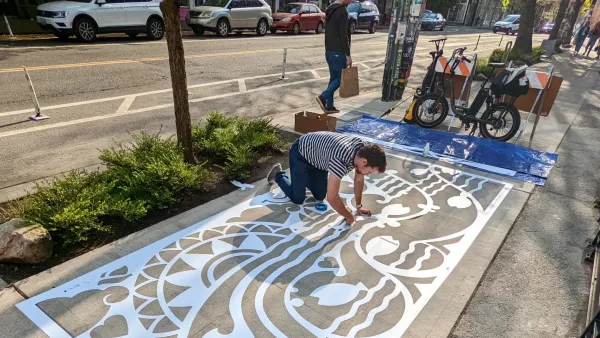
This Seattle sidewalk art only appears when it rains
Prompted to find a silver lining to the gloom of rainy Pacific Northwest days, an artist hit upon a novel solution: water-activated sidewalk paint.

Rise of the Instagram City
Cities have become obsessed with going viral.
Spotlighting the Women Shaping Seattle
The Urbanist is publishing a series of articles focusing on the leadership of women is shaping the past, present, and future of Seattle.

Planetizen Federal Action Tracker
A weekly monitor of how Trump’s orders and actions are impacting planners and planning in America.

Data reveals that NYC’s bet on congestion pricing has paid off
After almost two years of the program, reports show positive impacts on traffic and air quality and no disruptions to parking.

HUD modernizes 50-year-old manufactured housing framework
The Next Generation Manufactured Housing Action Plan establishes new energy-efficiency standards for manufactured homes, and new guidelines for anchoring them.

Small single-family homes are illegal in most of MA. Voters can change that
Most land zoned for single-family housing in Massachusetts requires at least 40,000 square feet of land per house.

Public steps inside U.S.’s first battery-powered train
Metra’s groundbreaking train feature modern seats and a futuristic battery car.

Companies show off AI technology, new innovation hubs at APTA Expo
Nearly 700 companies attended the American Public Transportation Association’s Expo last week, which happens once every three years.

FREE Course: Walkable City 1: Why Walkability?
After describing his path towards focusing on walkability as the essence of good planning, Jeff Speck marches through his five principal reasons for making more walkable places.
Reinventing Malls: Planning Alchemy—Turning Gray Fields Into Gold
The course focuses on the opportunities and imperatives that shape reinvention of mall sites.

One Hundred Miles
County of Mendocino
planning NEXT
The Architects Foundation
University of Cincinnati Online
Montrose County
Northern Illinois Transit Authority (NITA)
The Pocatello Development Authority